Showing posts with label japan. Show all posts

23.12.16

Connected cows and the greener pastures of big data

Blog post originally published on State of Digital as part of a monthly column.

cedric chambaz bing microsoft connected cows
Remember the cringing router sound that accompanied your early internet connections? Being a 40-year old father of two, when I hear that screeeeeeeechhhhhhhhhh I can’t avoid feeling a smile pop on my face. That sound reminds me, with a touch of nostalgia, of the cry of a newborn. It makes me smile as fond memories have overshadowed the dirty nappies and sleepless nights.

To a certain extent, that sound was indeed the cry of a baby internet, when browsing was a commitment and a flaming logo the pinnacle of creativity. The worldwide web has since grown up. A lot.

Small steps towards big data

Looking back, that dial-up buzz was literally the first signal in our digital footprint. We signed on. And in that very moment big data spun to life.
What were we learning from those early signals? Not much. We knew how many people were online and roughly where they were. But as the web of documents developed, search engines arose and our ability to understand people increased. We started to know what you wanted. Think about it: you probably tell search engines things you wouldn’t tell your closest friends. We understood that your inputs into a search engine were, on a personal level, an expression of your desire, and on a global level, an expression of the world’s consciousness. The so-called Zeitgeist.

Although I have spent the last 10 years in the realm of online advertising, in today’s article I will focus less on search marketing, and more on the information infrastructure and machine learning that Bing is part of, looking at how this is influencing our future. What are we doing with our data footprint? Over the course of the last year I have asked many people across Europe how the idea of data collection made them feel. By large, the response was discomfort and hesitance. Until provided with more perspective.

The heights of data complexity

So let’s get back to our story. In order to understand the complexity and depth of the data infrastructure that we are part of, let’s contemplate what has changed since the emergence of the first search engines. With each of these four changes and associated amount of data surge that came with it, you need to visualize a growing mountain.
First is your search habit. From a few searches per day to multiple searches per hour, we are now searching constantly, and not just you but also the billions of people who got online in the recent decade.

Second is your search access. Most of us had access to a desktop computer 20 years ago. But just one. A grey, cold box, sealed to a desk. We certainly couldn’t put it in our pocket and take it with us to a party. It is not just computers, think about all the devices you own which are harnessing computing power: laptop, tablet, smartphones, TV, but also your car and now your fridge.

The third big change is your search expression. You have gone from using basic computer commands, with amp signs and inverted commas, to using more human a language. You’ve gone from asking “what” to asking “why…” and “how to…”. In fact we have seen the growth of queries starting by Why being three-fold the growth of What queries, which means we are no longer looking for information, we are looking for answers. You’ve layered sequential searches on top of these, in a complex web of intents.

Finally, the integration of search with other infrastructures has also changed. A search engine used to be an isolated service. Now it’s plugged into the social graph. This means that several points of contact are linked and with them a flurry of new signals, millions of them that only a few super-computers are able to capture, organize, model and render. Search engines are the database of intents, and social networks are the depository of sentiments. We have developed the ability to process, analyze and understand these two humongous, historical and real-time information sets together.

The search crystal ball

We can understand your sentiment for certain events or entities, estimate popularity trends, as well as predict outcomes of future events. Microsoft has developed a program called Bing Predicts which combines and models all the data signals we can find, and comes up with incredibly accurate predictions. We initially explored popularity-based contests like American Idol, for which the web and social signals are very strong and highly correlate with popularity voting patterns. Bing Predicts could accurately project who would be eliminated each week during American Idol and who the eventual winner would be. Just by using all of the signals that are out there.

Getting more complex, we turned to sporting events and even world political challenges. During the World Cup in Brazil, our team predicted accurately with 100% accuracy the winners of the final elimination round. During the last year Rugby World cup, we had 80% accuracy across the tournament. Surprised? In order to successfully predict a sporting event outcome, the number and type of signals we incorporated quadrupled from what we used to predict a basic popularity event like American Idol. This is because we recognize that popularity alone does not predict whether a team will win – Sorry for the fans. A fan base has however special insights into the abilities of their teams, and those fans are having constant discussions about their team. This is called the Insider Knowledge. We up-weighted their knowledge against player and team stats, tournament trends, game history, location and even weather conditions. This is how we were successful in our predictions.

We finally turned our attention to political events, and in particular the Scottish referendum two years ago. The process and results were presented at TEDxSuzhou.


We were and are predicting the future. Can you imagine a business need that this kind of prediction can answer? Of course you can! We’re experimenting right now with predicting the upcoming trends in fashion, in automobile, in technology – so we can help our advertisers make smarter business decisions.

So we saw how predictions can play a role in entertainment, sport or business, fine. Fine, until we find a way to make this kind of data infrastructure even more meaningful, at a society and mankind level. What can we do with this capability that goes beyond entertainment and the novelty factor? Can we use our big data to make a meaningful impact on society?

Up close

All of this is exciting on a global or country level. When we’re talking about millions of inputs, it’s no wonder you can make predictions and have an impact like this. It is just a massive sample size. What about bringing this big data infrastructure to a personal level? Is it possible for a machine to learn so much about you that it can accurately predict your next move? Or predict when you will need something, and provide it? That is the promise behind digital personal assistant like Cortana.
Cortana is not only on Windows Phone but also Android and iPhone. And since the release of Windows 10, she’s even on your desktop. As outlined in a previous article, you set up Cortana with some basic info about yourself, then use her to help you with things like scheduling and reminders and web searches. Before you know it, Cortana is spontaneously sending you an alert to inform you that you should leave the office now to be on time for your next appointment in Farringdon, because she found some congestion on your normal route. It doesn’t take Cortana long to learn so much about you that she can predict your next move and offer assistance.

A new layer of data in your coat

While our mobile phones aren’t exactly wearables, we sometimes behave as if they are, keeping them on our body no matter where we go. With wearables, two important things converge: big data infrastructure and your expectations.

When you hear “wearables”, you probably think of a smart watch or one of these fitness bands. But to go back to my introductory analogy, these are just the first baby steps towards the full potential of wearable and how that technology will be able to enhance our capabilities, as individuals or as professionals. Think about it: wearables can capture and communicate signals about your location, your manner of travel – whether you’re on foot or in a car – time of day, most recent queries, usual route home from work, the weather, your physiological state, etc.

So for instance, if your wearable identifies that your hydration is low, it could prompt a notification that factors in your location, whether you’re moving, what time of day it is and therefore whether the nearby branch of your favourite coffee shop is open. It could even cross-reference this with your earlier interest in gingerbread lattes, and the fact that it is raining, and direct you to the nearest open coffee shop with plenty of indoor seating and gingerbread lattes on the holiday menu. Your wearable might even send you an alert for a coupon the coffee shop is offering.

Greener pastures ahead

As the wearable technology grows, your expectations for your experience with technology in general will change. And that is for the better. After all what the point accumulating data points like hoarders unless you do something greater about it. And if I have learned something about the internet, is that it is a fertile ground for creative usage of untapped opportunities.
Bing Cedric Chambaz Connected Cows
I am from the French Alps where I spent most of my summers walking the mountains with my grandmother. She used to herd cattle in these alpine pastures and she was telling me stories about how much each of her cows were almost like members of her family. They had names, and she could tell when something was wrong with any of them.
These days are gone. Nowadays a farm is no longer taking care of a small dozens of cows, but hundreds. The personal relationship of each animal is no longer an option. The story of the connected cows started with a farmer in Japan who was exhausted with the effort of figuring out the exact time his cows were fertile – because it is a very short window, only 12-18 hours every 21 days, and it happens usually between 10pm and 8am. Of course knowing this precise time of estrus would give farmers a chance to successfully inseminate the cows.

These are farms with hundreds of cows – you can image what a nightmare this would be to keep track. Could technology help? A farmer in Japan asked Fujitsu for help. Fujitsu consulted with some university researchers and they came up with this idea of putting wearables – pedometers – on the cows, and providing the data to Microsoft Azure, in the cloud, for analysis and alerts that go straight to the farmer’s smartphone.

It turns out that when a cow is in estrus, she paces. The number of steps she is taking increases tremendously, and this data alerts the farmer to the right moment for fertilization. The connected cow project has been 95% accurate – and that 5% where it misses the mark turns out to be when the cow actually skips the farm and goes missing.
Not only is this wearable incredibly accurate, it also helped the researches discover that there is an optimum window for fertilization if you’d like a female or if you’d like a male. With 70% probability, a farmer should fertilize in the first half of the estrus window if he needs more milk cows or if he needs more bulls. But it does not stop there… The Fujitsu researchers were able to also correlate pacing patterns with increased risks of genetic diseases and pathology.


It is amazing what data can tell you, if you know how to look at it. Sometimes creatively! This is the joy of data infrastructure. We can do wonderful things in the world when we collect, analyze and render the data that’s available to us. Microsoft is on the leading edge of this, with products like Power BI, Azure, our cloud platform but also Bing our search engine and its machine learning capabilities which can make sense of the millions other data points that come together to make big data smart, useful, creative and – yes – joyful. And you, what was the last time you found a creative inspiration in your data set?

12.6.15

The unbearable lightness of having

Ouch! I just walked yet on a lingering Lego bricks kindly left behind by one of my two boys as a token to their gratitude. Re-ouch! What did I trip over this time? Oh, just one of my wife's precious items from her impressive plastic bag collection (including this very special vintage edition by Tesco from 2007)...

Organised mess?


Many new parents will certainly sympathise, so yes I confess, I live in a flat that is cluttered... Books, toys, plastic and handbags, stilettos, pens and a few devices here and there (because the geek that I am does contribute to that mayhem, of course). No matter how creative you get with storage, they always seem to overflow. So the problem may not be the storage, but the content. Of course it is.

In fact, after having sold us alternatively the dreams that as the ultimate luxury was space or that some Swedish wizardry could help make more out of our jam-packed spaces, a more recent trend has emerged from the media. It is no longer about expanding or optimising micro-inches of cramped living space: it is now a matter of decluttering. If in the past, there was a relatively basic dichotomy between the have's and the have-not's, there is now amongst the upper-middle class a third category: the don't-want-to-have's. For them, it becomes a decision not to possess.

Inspired by Japanese Zen and Feng-Shui philosophies, this phenomenon is trending far and large in the press, as more and more books are released about how to tidy and clear out. You must admit this is in itself a bit schizophrenic... After all, avid fans may end up cluttering their house with books on decluttering!
Spring cleaning

Fad or trend? We are now in the very last days of Spring, and many of us have felt the almost therapeutic feeling of emptying cupboards and other hidden boxes from the junk we had been accumulating over the previous twelve months. Off with that candle holder in terracotta. To the bin the piles of Time Out magazines you have been promising your self to catch up on in order to be up to speed with what is hot... or, well, what was hot in June 2013 by the look of the cover of the edition you hold in your hand.

It feels good to reclaim some ground over the mess. It feels even better when you clear your conscious when you hand over your definitely too tight jeans to a charity on the high street. But it would be interesting to see how this trend evolves once the dust has settled. Nevertheless this phenomenon struck a cord with me (and not only because I have a profound admiration for Japan and obsessed by the necessity to bring order to chaos). It led me to another very contemporary divergence: possession versus materialism.

Is digitalisation cheating?

For years the concept of possession was necessarily associated to physical object. Wealth was measured by the ground you owned, the serfs ploughing your fields, the pile of gold you could put on the table... And then came the banks, and money got dematerialised. You had no more trinkets but access to money, an abstract concept. It was still your sweat and tears (or your servants), but it was no longer your very own treasure. There was no more attachment to the object itself, rather to its value.

Similarly, information which was once captured in pages, books and bookshelves was first digitised but still remained visible. It was on that floppy disk or in that server that was buzzing in the corner of the office. It was not looking like a good old book anymore, but it was still there. This changed with the rise of Cloud computing. With it, the virtualisation accelerates and objects further dematerialise. Like the golden nuggets an jewels which were replaced by bank statements, books, disks, CD, cassettes, external hard drives, servers... are disappearing from the local premises to see their quintessence hosted somewhere in the cloud.

Slowly the reticence of not being able to touch-to-own is fading. People are perceiving the value of virtualisation: easy and ubiquitous access; lower costs as you pay only for the storage you actually need; security of having your assets backed up in several locations... Of course there are hackers, like there were bank robbers, and there are still people who don't trust the cloud like many did not trust bankers and preferred to sleep with money under their matrass. But there are also genuine enthusiasts who are seeing in technology the opportunity to live the above-described trend to its fullest. 

Technologically-enhanced lives

I indeed recently met that technophile whose job was to educate businesses about the latest evolutions and what they entail in terms of opportunity. As a technologist, he had decided to explore how far he could go in adopting technologies which could help him get rid of the unnecessary. He got a chip inserted under the skin, a bit of code here and there, and off he went to dematerialise his home. Sensors capture his presence and switches on and off the wifi, the lights, the heating system, etc. automatically based on agreed gestures, rules and orders passed through his phone. The keys to his flat were rapidly gone too, as his unique identifier emitted by his chip could open the door lock through NFC. Whilst many of us switch between different screens, he opted to retain only one, acknowledging that smartphones nowadays are sufficiently powerful to be a TV, a PC, a watch and even a phone. Why having a fridge if you could get his daily food intake delivered fresh to his door, prepared to meet his dietary requirements? One by one, he went through his inventory and tried to get rid of what was not really needed. He wanted to go back to the basics... Connected basics. 

This leads to some interesting points of reflection: the digitalisation of the world implies the rise of a new paradigm where you can own without possessing. You still own information, tunes, photos... but they do not materially exist any more. This means that the renunciation to physical ownership does not necessarily jeopardise the codes of our Western societies. Pushed to the extreme, wealth could materialise in absence of physical possession whilst the poorest would be the ones anchored in a material world, unable to digitised... Internet behind a social walled garden, so to speak.

In that hypothetical, yet plausible world, Maslow's pyramid of needs may see "wifi access" being added to its lower, more basic needs. This is one of the scenarios that the Singularity University explores during their curriculum: "how to apply exponential technologies to address humanity’s grand challenges" with a democratised access to the internet as a prerequisite to avoid a new social rupture between the connected and the disconnected. This is also why companies like Google are exploring ways to give access to the internet in creative ways like the Loon project (and not to expand the reach of their advertising audience of course).

Tidying my thoughts

Personally, I am enthused by what new technologies can offer, and as a humanist, I believe in our ability to keep the potential demons at bay. Without going to the extreme of my technologist, I am slowly decluttering my flat, saving one foot nail at a time my physical integrity, my sanity, and hopefully a tiny bit of the planet by not consuming beyond what I really need. I am from the Generation X, that generation who has come to the world amidst the recession after years of prosperity. Because of that, I am more than ever convinced that we are therefore a transitional breed, and probably better suited than anyone to help facilitate and educate the change without being blinded by optimism or pessimism. We are an agent of change. For the better.

17.11.13

Melody... Nippon Style

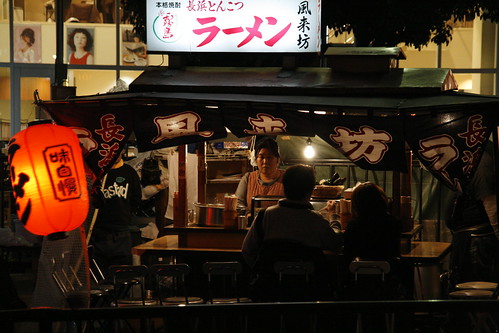
Food stalls
Asian noodling.
 
Last year Korea was trusting the world music charts with a Psy-chedelic tune that was all the more representative of the emancipation and internationalisation of the country, let alone region. I have personally never been to the Country of the Calm Morning, but have done a few immersions in the broader eastern region. If I loved walking the unspoilt Burmese countryside, the constant smile of the Malaysian people, the spices of the thailandese food... It is really Japan that caught my imagination, like no other (as Sony once said in its advertising).

I belong to the generation X, which means that I have grown up with the rise of that nation on the international scene. Sega and Nintendo have kept me awake at night ; Shizuo Koizumi and his anime "Attacker Yu!" (Jeanne & Serge in French) made me discover volley ball and live magnificent moments with great fellows ; I have delightfully seen sushi bars take over France restaurant scene like Pizzerias did in the 70s, Vietnamese restaurants in the 80s, Kebab shop in the 90s... It was therefore natural for my wife and I to aim for the archipelago when evaluating our honey moon destinations.

Nippon Style.

It was already a few years back, and I have written a few articles on that experience, but what I recall most is this frenetic calm that tears appart that nation. On the one hand Tokyo and its always-on beats, strobe lights and capsule hôtels, and on the other hand the traditions and relaxing nature of the Takayama region.

And it is always a pleasure to dive back in these fantastic memories through the pictures I brought back, or thought more serendipity. The latest happy accident was this advertisement for the Touchwood SH-08C, a very special phone by Sharp and launched by NTT Domoco.

As introduced in Engadget:
Kenjiro Matsuo was responsible for the creation of the instrument, while Morihiro Harano is being handed credit for the idea itself; in fact, he confirmed to The New York Times that no artificial music was added whatsoever, with only the background levels being adjusted up for effect. You may have never listened to a piece of classical music in your life, but you're sorely missing out if you ignore Bach's Cantata 147, "Jesu, Joy of Man's Desiring." Or, at least the version in that video below.

6.6.09

Slick chop-stick-style.

Japanissimo.

Just bumped into this vlog (video blog) about an American in Tokyo. Kevin Cooney is a writer, comedian and performer born and raised in New York but currently residing in Japan. His approach is somehow aligned with my own take on life that I try to capture in my own blog: cultural differences are interesting, even if they can make you smile at times.

Since I have myself walked the streets of Tokyo and Japan, his stand-up resonates to me. But I guess it would to anyone genuinely open-minded about what is available out there. What I liked about Japan was that the cultural choc is not biased by a so-call difference of economic development. This country is as advanced if not more than most of the Western countries. They have simply adopted a different route which drove them in a different place. Not better, not less enticing. Simply different.

Here is episode #1 of the series of mini-clips, shot in 2006:

To read further:

19.3.09

A breeze of fresh air

The best run ever

I will not crack a series of bad jokes on running to the loo, sliding marks, etc. No, I am not scatological enough to clutter this page with such vocabulary. However, I am from the French Alps, and I have also visited Japan recently, as a result, I could only be seduced by these Japanese toilets...
"Regular" Japanese bogs are already over-equipped with interesting features, including well-positioned water and air jets, heated seating, onboarded music to cover up your own soundtrack and preserve your integrity... So I was just wondering if this limited edition had a few more tricks in its bag. I don't know: evergreen scents, chilled breeze to give the feeling of speed, clapping and crowd roaring to encourage your skiing performance, etc.

In fact, I am not sure to let my brain wander any further, because I am certain that it will never even come close to the reality. Japanese toilets rules, that is all.


To read further:

22.11.08

Japanese pictures

As promised earlier, here are a few pictures of my journey in Japan. Clearly a different country, at every levels:

25.9.08

Eat your Japanese carrots, Boy!

Your plate is your future.

When you are young and reluctant to eat what's in your plate, your parents always come back to you with some absurd rationals on why you should tuck in. They try to find in your plate some omens of your favourable future, just like Greeks were looking at the inners of a sacrificied animal for good auspices...

And the worst thing is that candid and credulous as a child can be, they tend to believe it all. Interestingly enough we even have a colloqual expression in French for "falling for a story": we say that someone "à gober l'histoire", literally "has swallowed the story".

The kind of lies or popular culinary legends argue that if you "Eat your soup and you will grow tall and strong", if you "Eat your spinach and you will be strong like Popeye"... And when it comes to carrots, well, there are two options:
  • first for naughty children : "eat your carrots, they'll make you kind and polite"
  • Alternatively, for organic and nutriceuticals friendly-parents: "eat your carrots, they'll make your bum skin soft and rosy"

Japanese loneliness.

These children stories came back to my mind when eating in a Japanese restaurant (to prepare myself for my upcoming trip to the country of the Rising Sun), I faced this bottle of still water. Now, I don't read ideograms, but I thought the imagery was quite explicit... It seemed that by hydrating myself I would improve the tonus of my bum. After all, we are made of more than 60% of water so that would make sense. And is the last ideogram just pointing at the areas where the benefits will be the most obvious???

As I said I am about to leave for a three-week journey in Japan, and I had a sudden flashback at Bill Murray in Lost in Translation when living this "experience". I will soon be the one hanging desperately around in Shibuya... Better go to my fridge and grab my last bunch of carrots to remain kind and polite during my whole stay.