I was recently invited to contribute to Movidiam's podcast and share my thoughts on the future of search, chat bots, Artificial Intelligence, the rise of Augmented Reality and their impact on marketing. If you regularly read this blog, you will be familiar with some of the concepts and principles that I am touching base on, but nonetheless you may be inclined to stop reading and start listening to my French accent:
Blog post originally published on State of Digital as part of a monthly column.
The IAB UK has just released their digital advertising spend report for 2016 and announced that digital advertising grew at its fastest rate for nine years – up 17.3% to £10.3 billion. The last time annual growth was higher was in 2007 (+38%), when Apple released the iPhone leading to the accelerated adoption of smartphones, the emergence of the app paradigm, etc. The reason I call out that historical reference is because I genuinely believe we are at an equivalently critical inflexion point with the rise of AI: it grew out of search and is about to transform marketing as a whole.
As a matter of fact, the historical powerhouse of the digital landscape, Search, has continued to grow by +15% to £4.99 billion, which reflects two major trends:
First advertisers have (finally) realised that search plays a role throughout the customer decision journey and not just at the final conversion step
Second, search is, in itself, evolving drastically to offer new capabilities and surfaces of engagement for advertisers to capture new intents, new behaviours, new usages
Following a modern consumer journey and its query paths
As disruptive technologies reshape the digital marketing landscape, brands are investing time and effort to remain relevant and top-of-mind with consumers. For years, search marketers have obsessed over bottom of the funnel activity for its seemingly higher CTRs and conversion rates, in part fuelled by last click attribution models. But most marketers today agree that it is essential for a brand to appear across all stages of the funnel to drive brand affinity and recall.
Research at Bing Ads now allows us to quantify and better understand the customers behind the clicks and where they stand on the customer decision journey (CDJ). Consumers tend to go through five distinct stages, which vary depending on the type of purchase: initiation, research, comparison, transaction and experience. Consumers are subject to these same five CDJ stages, although each step will vary in length and importance depending on the cost of failure, frequency, cost and complexity of the task, and the shopper type.
As consumers go through a given decision journey, search plays a pivotal role and different types of queries will be used throughout:
Category searches: Include broad search terms that are not product or brand specific, such as shoes, running shoes, hiking shoes. These usually appear during the initiation, research and comparison stages but can also take part during transaction
Tangential searches include queries that are related to a given journey, but not in the exact same category. For instance, if I am searching for running shoes, a tangential search could be about preparing for a half marathon, running training program or running equipment. These are similar to category searches in that they usually get searched on before a transaction
Competitor brand searches: Include your competitors’ brands or products. This is an opportunity for your brand to appear through conquest advertising. For Nike, these terms could include Under Armour, Adidas, etc. As consumers get further along their decision journey they begin to hone in on their purchase and more specific searches occur
Brand searches: Include a specific brand or product name. Nike is the brand and product searches could include Nike Pegasus or Nike Running shoes. Brand terms are often the best performing keywords helping drive the most transactions
Search drives awareness
Traditionally search has placed a premium on brand keywords. The Bing Ads research team has found new insights on the role of non-brand search terms within today’s journeys. Brand Impact Study on usage data from a major US auto retailer determined that 72% of brand ad clicks (which includes category, competitor and tangential searches) had a non-brand keyword precede the brand click. In other words, retailers who do not run non-brand keywords throughout multiple stages of decision journeys are missing out on a majority of relevant searches and leaving gaps for their competitors.
Additionally, consumers who are exposed to a brand ad on a category or competitor query were 30% more likely to do a branded search. On average they had a 15% higher conversion rate compared to consumers who were not exposed to the brand ad. Having a branded ad appear in category and competitor brand queries improved brand affinity and recall, and increased the propensity for future brand searches.
Another Bing Ads research completed in Q3 2016 with a leader in the automotive insurance vertical measured brand awareness and perception based on exposure to ads within the search results pages. The key learning from this study was that searchers on Bing who saw a branded ad for non-branded search queries showed a statistically significant increase in brand awareness, perception and purchase intent. After being exposed to a branded ad, searchers indicated a 24% lift in unaided awareness, 28% lift in purchase intent and a 30% lift in viewing the retailer as a market leader. Brand awareness further improved when searchers clicked through on the ad and were taken to the brand’s landing page. In the study, consumers who were merely exposed to an ad without clicking on it, self-reported as more likely to take an action or next step
Although search marketers have long assumed some level of brand awareness in search, it is the amount of brand awareness shown here that proves impressive and indicates the importance of staying present throughout each stage of a journey
Search informs and educates
As consumers go through the initiation phase of the consumer journey and begin to do more research and consider purchasing, search can help with the decision-making process.
A Forrester Consumer Technographics study called out that 60% of consumers will use a search engine to find the product they want and 61% will read product reviews before making a purchase. And one of the most trustworthy sources in this research and comparison phase is none other than search engines. Furthermore, consumers consistently rely on search engines, more than any other source, as a reliable place to research about brands, products, or services that they are considering buying. According to Forrester, 49% of consumers reported that they rely on search to inform purchase decisions, and 19% of respondents identified search engines as the most influential source in driving their decisions.
New search experiences, new marketing expectations
The evolution of the consumer behaviours outlined above and the reaction from marketers by investing throughout the different stages of the consumer journeys are a sign of maturation for a discipline that is merely 15 years old. And yet, new search experiences powered by AI are coming to the fore, and are likely to further disrupt the model.
It has been well documented that search is no longer just a search box on a webpage with a list of links. It is literally breaking out of the box; it is changing in some dramatic and exciting ways. Once a function that used to be limited to a text box on a specific site has slowly been integrated into more and more of the technologies/devices, apps and sites we use every day, from phones to gaming consoles. As such, Search becomes more pervasive, but also more personal and predictive.
Conversations as a Platform is a great embodiment of how the Future of Search makes sense of these 3P (personal, predictive and pervasive). The rise of messaging apps where consumers now spend most of their time and technological advancements in NLP, AI and machine learning are creating rupture that is similar to what we have seen in decades past with the App paradigm. Conversations as a platform unlock a more human, personal way to discover, search for, access and interact with information. This new platform will enable us to interact with devices more intuitively, using natural language conversations, evolving us from mechanical keyboard and mouse to touch and beyond.
Search will never again be a constrained to writing in a search box. Instead, search will be a partner that can listen and communicate in dialogue with a consumer on any platform and any device. Thanks to new, more natural interfaces, voice search is becoming increasingly possible and accurate. We imagine a rich ecosystem of conversations, ones that include: people to people, people to your personal digital assistant, people to bots, and even personal digital assistants calling on bots on your behalf. That’s the world that you’re going to get to see in the years to come.
We have already covered the current rise of voice search as a result of mobile search adoption, but it is likely to further accelerate as search becomes more pervasive and turns your TV Set, you fridge or your car into a search box. ComScore predicts that by 2020, over 40% of the queries will be voiced rather than typed. It is worth noting that these experiences are often screenless which further disrupt the preconceptions that too many marketers have when they think they have nailed their search strategy.
How do you optimise your web presence for voice search? How do you market to chatbots? How will we see consumer intent evolve in these new experiences? We already seeing that 16% of searches every month had never searched for before. We also see that 25% of the clicks on the Bing Network are from searches not happening on Google… So, the versatility of the above-mentioned consumer journey is likely to continue to increase. And what an exhilarating evolution it is!
Back in March, as my team took part in Advertising Week, I was honoured to be invited by Jason Miller, from the Sophisticated Marketer podcast, to deep dive into the evolution of Artificial Intelligence, Chatbots and what it means for marketers and how they can utilize the technology now and prepare for the future:
Blog post originally published on State of Digital as part of a monthly column.
Remember the cringing router sound that accompanied your early internet connections? Being a 40-year old father of two, when I hear that screeeeeeeechhhhhhhhhh I can’t avoid feeling a smile pop on my face. That sound reminds me, with a touch of nostalgia, of the cry of a newborn. It makes me smile as fond memories have overshadowed the dirty nappies and sleepless nights.
To a certain extent, that sound was indeed the cry of a baby internet, when browsing was a commitment and a flaming logo the pinnacle of creativity. The worldwide web has since grown up. A lot.
Small steps towards big data
Looking back, that dial-up buzz was literally the first signal in our digital footprint. We signed on. And in that very moment big data spun to life. What were we learning from those early signals? Not much. We knew how many people were online and roughly where they were. But as the web of documents developed, search engines arose and our ability to understand people increased. We started to know what you wanted. Think about it: you probably tell search engines things you wouldn’t tell your closest friends. We understood that your inputs into a search engine were, on a personal level, an expression of your desire, and on a global level, an expression of the world’s consciousness. The so-called Zeitgeist.
Although I have spent the last 10 years in the realm of online advertising, in today’s article I will focus less on search marketing, and more on the information infrastructure and machine learning that Bing is part of, looking at how this is influencing our future. What are we doing with our data footprint? Over the course of the last year I have asked many people across Europe how the idea of data collection made them feel. By large, the response was discomfort and hesitance. Until provided with more perspective.
The heights of data complexity
So let’s get back to our story. In order to understand the complexity and depth of the data infrastructure that we are part of, let’s contemplate what has changed since the emergence of the first search engines. With each of these four changes and associated amount of data surge that came with it, you need to visualize a growing mountain. First is your search habit. From a few searches per day to multiple searches per hour, we are now searching constantly, and not just you but also the billions of people who got online in the recent decade.
Second is your search access. Most of us had access to a desktop computer 20 years ago. But just one. A grey, cold box, sealed to a desk. We certainly couldn’t put it in our pocket and take it with us to a party. It is not just computers, think about all the devices you own which are harnessing computing power: laptop, tablet, smartphones, TV, but also your car and now your fridge.
The third big change is your search expression. You have gone from using basic computer commands, with amp signs and inverted commas, to using more human a language. You’ve gone from asking “what” to asking “why…” and “how to…”. In fact we have seen the growth of queries starting by Why being three-fold the growth of What queries, which means we are no longer looking for information, we are looking for answers. You’ve layered sequential searches on top of these, in a complex web of intents.
Finally, the integration of search with other infrastructures has also changed. A search engine used to be an isolated service. Now it’s plugged into the social graph. This means that several points of contact are linked and with them a flurry of new signals, millions of them that only a few super-computers are able to capture, organize, model and render. Search engines are the database of intents, and social networks are the depository of sentiments. We have developed the ability to process, analyze and understand these two humongous, historical and real-time information sets together.
The search crystal ball
We can understand your sentiment for certain events or entities, estimate popularity trends, as well as predict outcomes of future events. Microsoft has developed a program called Bing Predicts which combines and models all the data signals we can find, and comes up with incredibly accurate predictions. We initially explored popularity-based contests like American Idol, for which the web and social signals are very strong and highly correlate with popularity voting patterns. Bing Predicts could accurately project who would be eliminated each week during American Idol and who the eventual winner would be. Just by using all of the signals that are out there.
Getting more complex, we turned to sporting events and even world political challenges. During the World Cup in Brazil, our team predicted accurately with 100% accuracy the winners of the final elimination round. During the last year Rugby World cup, we had 80% accuracy across the tournament. Surprised? In order to successfully predict a sporting event outcome, the number and type of signals we incorporated quadrupled from what we used to predict a basic popularity event like American Idol. This is because we recognize that popularity alone does not predict whether a team will win – Sorry for the fans. A fan base has however special insights into the abilities of their teams, and those fans are having constant discussions about their team. This is called the Insider Knowledge. We up-weighted their knowledge against player and team stats, tournament trends, game history, location and even weather conditions. This is how we were successful in our predictions.
We finally turned our attention to political events, and in particular the Scottish referendum two years ago. The process and results were presented at TEDxSuzhou.
We were and are predicting the future. Can you imagine a business need that this kind of prediction can answer? Of course you can! We’re experimenting right now with predicting the upcoming trends in fashion, in automobile, in technology – so we can help our advertisers make smarter business decisions.
So we saw how predictions can play a role in entertainment, sport or business, fine. Fine, until we find a way to make this kind of data infrastructure even more meaningful, at a society and mankind level. What can we do with this capability that goes beyond entertainment and the novelty factor? Can we use our big data to make a meaningful impact on society?
Up close
All of this is exciting on a global or country level. When we’re talking about millions of inputs, it’s no wonder you can make predictions and have an impact like this. It is just a massive sample size. What about bringing this big data infrastructure to a personal level? Is it possible for a machine to learn so much about you that it can accurately predict your next move? Or predict when you will need something, and provide it? That is the promise behind digital personal assistant like Cortana. Cortana is not only on Windows Phone but also Android and iPhone. And since the release of Windows 10, she’s even on your desktop. As outlined in a previous article, you set up Cortana with some basic info about yourself, then use her to help you with things like scheduling and reminders and web searches. Before you know it, Cortana is spontaneously sending you an alert to inform you that you should leave the office now to be on time for your next appointment in Farringdon, because she found some congestion on your normal route. It doesn’t take Cortana long to learn so much about you that she can predict your next move and offer assistance.
A new layer of data in your coat
While our mobile phones aren’t exactly wearables, we sometimes behave as if they are, keeping them on our body no matter where we go. With wearables, two important things converge: big data infrastructure and your expectations.
When you hear “wearables”, you probably think of a smart watch or one of these fitness bands. But to go back to my introductory analogy, these are just the first baby steps towards the full potential of wearable and how that technology will be able to enhance our capabilities, as individuals or as professionals. Think about it: wearables can capture and communicate signals about your location, your manner of travel – whether you’re on foot or in a car – time of day, most recent queries, usual route home from work, the weather, your physiological state, etc.
So for instance, if your wearable identifies that your hydration is low, it could prompt a notification that factors in your location, whether you’re moving, what time of day it is and therefore whether the nearby branch of your favourite coffee shop is open. It could even cross-reference this with your earlier interest in gingerbread lattes, and the fact that it is raining, and direct you to the nearest open coffee shop with plenty of indoor seating and gingerbread lattes on the holiday menu. Your wearable might even send you an alert for a coupon the coffee shop is offering. Greener pastures ahead
As the wearable technology grows, your expectations for your experience with technology in general will change. And that is for the better. After all what the point accumulating data points like hoarders unless you do something greater about it. And if I have learned something about the internet, is that it is a fertile ground for creative usage of untapped opportunities. I am from the French Alps where I spent most of my summers walking the mountains with my grandmother. She used to herd cattle in these alpine pastures and she was telling me stories about how much each of her cows were almost like members of her family. They had names, and she could tell when something was wrong with any of them. These days are gone. Nowadays a farm is no longer taking care of a small dozens of cows, but hundreds. The personal relationship of each animal is no longer an option. The story of the connected cows started with a farmer in Japan who was exhausted with the effort of figuring out the exact time his cows were fertile – because it is a very short window, only 12-18 hours every 21 days, and it happens usually between 10pm and 8am. Of course knowing this precise time of estrus would give farmers a chance to successfully inseminate the cows.
These are farms with hundreds of cows – you can image what a nightmare this would be to keep track. Could technology help? A farmer in Japan asked Fujitsu for help. Fujitsu consulted with some university researchers and they came up with this idea of putting wearables – pedometers – on the cows, and providing the data to Microsoft Azure, in the cloud, for analysis and alerts that go straight to the farmer’s smartphone.
It turns out that when a cow is in estrus, she paces. The number of steps she is taking increases tremendously, and this data alerts the farmer to the right moment for fertilization. The connected cow project has been 95% accurate – and that 5% where it misses the mark turns out to be when the cow actually skips the farm and goes missing. Not only is this wearable incredibly accurate, it also helped the researches discover that there is an optimum window for fertilization if you’d like a female or if you’d like a male. With 70% probability, a farmer should fertilize in the first half of the estrus window if he needs more milk cows or if he needs more bulls. But it does not stop there… The Fujitsu researchers were able to also correlate pacing patterns with increased risks of genetic diseases and pathology.
It is amazing what data can tell you, if you know how to look at it. Sometimes creatively! This is the joy of data infrastructure. We can do wonderful things in the world when we collect, analyze and render the data that’s available to us. Microsoft is on the leading edge of this, with products like Power BI, Azure, our cloud platform but also Bing our search engine and its machine learning capabilities which can make sense of the millions other data points that come together to make big data smart, useful, creative and – yes – joyful. And you, what was the last time you found a creative inspiration in your data set?
Blog post originally published on State of Digital as part of a monthly column.
The motivational quote encourages us to “think outside the box”… But for once, I want you to think behind the box. Have you ever thought about the cogs, bots, artificial intelligence and other algorithms that are getting in motion every time someone hits the “search” button? The computing forces in motion are staggering and the amount of data that is crunched and produced is even more. Lines and lines of data, with in each of them a little piece of insight that could make all the difference in your marketing strategy. If only… If only you could overcome the spreadsheet blindness and see them.
Several of my posts in State of Digital are about visionary topics: the rise of AI, predictive modelling applied to individuals, digital transformation and the lessons that search engines could give to other businesses… This month, I was keen to be more tactical, and explore a little bit further the capabilities of the beloved Excel when it comes to making sense of large amount of data.
Picture that emotion
Advertising is all about creating an emotional bond between a brand and consumers. And since the infancy of our discipline, both marketers and agencies have been trying to visualize this connection. Focus groups, vox pop, surveys, research… They all had a go at it. But personally I never got fully satisfied by them. As a matter of fact, I don’t believe that people give you access to their core beliefs when prompted over the phone or in the street.
Then Social Media arose. And you must admit that they are simply great for that corollary use. After all, what are these platforms but the depository of our intimate sentiment?
So obviously you can have a quick peek at Facebook and look up for the fan pages for your brands. That is straightforward as people are overtly expressing their sentiment towards the brand through these pages. They revive dormant products and re-energize old brands. They also virtually stone others to death.
But what if you are interested in emotions more deeply engrained in consumer minds? And looking at visualizing them? Personally I used to visit photo sites like Flickr or Instagram and run a query on a given brand. Type Bailey’s and you will get hundreds of pictures showing up. The resulting mosaic is fantastically enriching. You will of course see people sipping their favorite liquor but also loads of pictures of dogs and cats named after that brand. What a better proof of brand advocacy than to name your beloved pet after a trademark? Or to tattoo the swoosh on your hip or a Harley Davidson eagle on your shoulder?
Think outside the (search) box
This digression meant to make a point: we can find consumer insights everywhere. You just need to be a bit creative to see them. I remember discovering Bing Ads Intelligence tool, and having one of these ah-ah moments.
This tool is by essence a brilliant search marketing tool that enables search marketers to make more informed choices when creating a campaign: based on historical and forecasted data from Bing search queries, it provides you for any keyword with traffic volumes, demographical and geographical information about the searchers, even indicative CPC for the different positions in the auction… And it is free!
If you have not downloaded it yet, I would strongly recommend you do. Even if you are not working in search marketing. In fact, I should say “especially if you are not working in search”.
This little freeware can indeed help a lot of marketers out there. As a matter of fact, in the current economic climate, when costs are cut to their bare minimum, can you afford to research what your audience’s actual demographic profile is and where they live? Are your pockets deep enough to run a regular research to audit your brand awareness against this audience?
Search engines are for finding
Digital expert and author John Battelle once qualified search engines as the database of intents. With over than 28m unique users in the UK alone, Bing offers you a statistically relevant sample of these intentions. So why not use the Bing Ads Intelligence to run your own piece of research? It provides you access to actual logs, so you can use them as proxy for your consumer intents. How many consumer have searched for your brand in the last month, and how many have for your competitors? That will provide you with a good indication of your brand awareness. Did they search on a PC or from a mobile device? Have queries increased after your latest local TV campaign? Was your regional billboard campaign efficient? Where are visitors searching from? London, Liverpool, outside the UK?
A lot of these questions can be answered and visualized by pressing a button in Excel. Three actually.
Three Excel features to make your data click
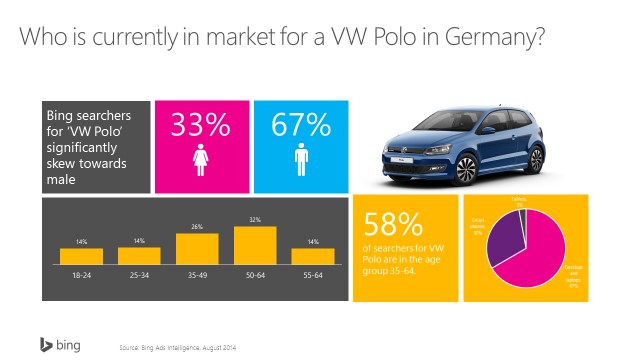
The first click should be on Bing Ads Intelligence. As said, you just have to enter a word (a brand for instance) and choose what you want to know: demographics, device usage… And since you are in Excel you can rapidly turn the data into a compelling visualization like this:
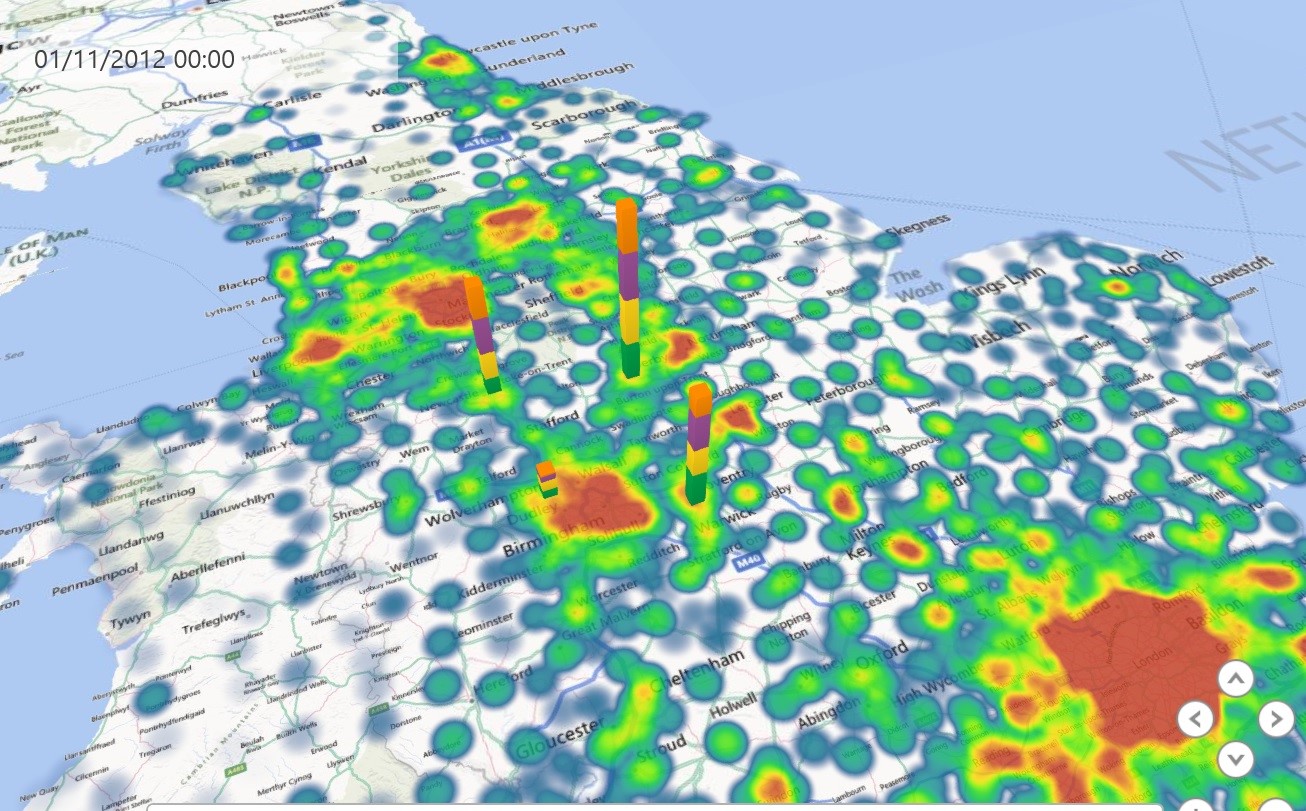
Now knowing more about who searched, my second click would be on another Excel free tool, PowerMap. If you are running Office 365, this is a native feature in your ribbon. If you are using an earlier version, you can download that add-on for free. Power Map is a 3D visualization add-on for Excel for mapping, exploring, and interacting with geographical and temporal data, enabling people to discover and share new insights. It allows Excel to automatically chart the search data to see where the customers who are searching for you are located, where your revenue is generated, where prospects are congregating, etc. I particularly like that if you have your data points for several periods, you can turn your map into a little video which will illustrate the evolution of your chosen KPI over time. The brilliant thing in this feature? Excel does all the work for you. Leveraging Bing technology, it recognizes the geo-information present in your spreadsheet and plots the relevant data points on a map accordingly.
Of course, neither tool will ever replace a full professional research or extensive monitoring application, but these are valuable indicators and visualizations for a superior desk research. Personally I find these free tools simply brilliant for those who are always looking for innovative ways to increase cost-efficiently their agility, identify new opportunities and niches.
Who, where and now when?
My third click would be to dig into the question of time and create a day parting heat map using the conditional formatting of Excel to rapidly identify when is my marketing sweet spot. How do you do that? Conditional formatting is a brilliant function that allows you to automatically change the format of a cell, based on values and parameters that you dictate. So let’s say that you have a search account report that you downloaded from Bing Ads with Hour of Day as the unit of time. It would originally look something like this (painful to watch you would reckon):
Highlight each column individually and use conditional formatting. We then see a picture of account performance by time of day, and a heat map emerge. I’ve left the Clicks, Impressions, Cost, and Converted Clicks columns untouched right now, as I prefer to display those with a different formatting. The red vs. green distinction is a little too arbitrary for these numbers, so I go with a bar graph to show them instead.
Now this chart tells us a story. It portrays the ebb and flow of our daily traffic, and it clearly shows us both where we can pull back on our bids with day-parting modifiers – early morning from midnight to 4 AM – and where to be more aggressive. We have a real lost opportunity here starting at 4 PM to 8 PM to increase our bid modifier and gather even more traffic. Our Average Position and Average CPC metrics let us know exactly when our competitors are ramping up their spend, and the hours in which we should do the same… until about 10 PM, when our conversion rate drops again.
This report takes less than five minutes to pull, and no custom modifications were made to these rules aside from highlighting each column individually and selecting the right formatting. Day-parting is the easy and obvious use for this kind of analysis, but it can also assist in ad reviews, geographic performance… really, in any case that leaves you staring at a spreadsheet for hours on end, mining for insights.
To go further
So you’ve manipulated and made your data more digestible. It has worked and you have identified some interesting data points but now you want to tie this in with the rest of your company’s data sources and tell a story. That is when tools like Power BI become handy. It indeed allows you to connect your data with a wide variety of data sources, from local on-premises databases to Excel worksheets to cloud services. Currently, over 59 different cloud services such as Facebook and Marketo have specific connectors, and you can connect to generic sources through XML, CSV, text, and ODBC. Data.gov for instance is a great base of public domain data set that you can mash with your own.
So what can this mean? How about comparing the demographic profile of your audience with the latest census? Identify the correlation between your customer engagement and the weather variations? There is so much data out there, it is really just about letting your creativity unleash the power of insights. Or when data becomes clear, and actionable.
The 31st Olympiads have started, and I am ecstatic. I indeed have a personal relationship with this global event since I was born in an Olympian city, Grenoble, just like my kids who saw the light in London. I have particularly fond memories of London 2012, and wish to my Carioca friends to experience the same exhilarations we had back then.
The Olympics are a fantastic platform to see human nature at its best: physical exploits, determination, team work, perfection, apolitical statements and some more loaded, the highest degrees of emotions like happiness and despair, intertwined and simultaneous. You simply cannot remain unmoved by this competition. When tears blend with sweat. Why cries of joy cohabit with cries of distress. When pain is the path to pleasure.
However something which gives me even more goose bump is what Paralympians achieve. It is close to superhuman. At least that is what Channel 4, the Paralympic official broadcaster, claims:
Enabling abilities
It is incredible what these so-called "disabled" athletes are actually able to achieve. In many ways they are more capable than many of us. Actually, Oscar Pistorius did compete in the London 400m race against "able" athletes...
His participation raised some questions at the time, because observers wondered if his handicap was an unfair advantage over the other competitors. Actually, to be precise the debate was not exactly on the handicap itself, but rather on the technology used to address it: the blades. Would the blades provide extra spring and pace that human legs would not be able to provide?
More interestingly, it raised an ethical debate which tells a lot about human nature: it was less about diversity and inclusion of disable athletes amongst able competitors, but would Pistorius' participation set a precedent and open the door to technology-enhanced bodies? After all, if some are ready to inject some illegal chemical in their metabolism to enhance their performances, would some be ready to deliberately alter their body to integrate some technology that would multiply their capabilities? What is disability? Could some weirdoes mutilate themselves to compete? Scary, but plausible.
Technology opening doors.
Debate aside, I am amazed by how some technologies are enabling people to live up to the Olympic motto: faster, higher, stronger. More capable in other words. I find this exciting, don't you? And not just in sport... I already wrote about how technology helps with the virtualisation and dematerialisation of our lives. But technology is capable of such grand things, like allowing deaf people to hear or colour blind people to discover the chromatic gamut. Let me introduce you to Neil Harbisson, a Catalan-raised but British-born artist and cyborg activist who has made the headlines for having an antenna implanted in his skull and for being officially recognised as a cyborg by a government. The antenna allows him to perceive visible and invisible colours such as infrareds and ultraviolets via sound waves. In other words, he does not see colours... He hears them. Each colour is associated to a sound, and with each sounds comes associated emotions.
What I like about this last example is that it redefines entirely the notion of ability. Technically, Neil is not able to see colours, but he has invented a new way to perceive them and in fact this new ability is richer than the classical sight because it spans beyond the human visible spectrum. Just like these athletes are not just emulating able athletes, they are defining new performances in totally new categories. They are shifting the battle ground to places where they are not disable... To places where they thrive. For that and for everything they do, they have my unconditional respect and admiration.
Blog post originally published on State of Digital as part of a monthly column.
If I were to deliver a sales pitch I would want to leave you with one figure; it would be 18%. But I am not a sales person and these pages are not meant to be commercially minded. I am the Head of Marketing in Europe for Microsoft search advertising, and that number made me realise how much transformation the search industry has undergone, and how rich a lesson it could teach marketers. According to comScore, 18% is the number of searches performed monthly on Bing in the UK. This represents 756M queries per month, 3Bn across Europe and this is a fast growing number since Windows 10 users tend to search 30% more on Bing after their upgrade. Three billion, that is already a lot of queries, and a lot of words typed in a search box.
Keywords have been king in the search marketing business for years. But we do not advertise to numbers or words: we market to people.
The evolution of search: from searches to searchers
For years, search engines have proved themselves as the gateway to the web, an entry point to the content of web pages people wanted to read. However people don’t want to just read anymore, they want to publish, play, share, watch, exchange, etc. The way they search has evolved too: they have gone from asking “what” to asking “why…” and “how to…”. We have seen a three-fold growth of queries starting by “Why” compared to “What” queries. This means people are no longer looking for information, they are looking for answers. These expectations have increased with the rise of new search experiences like Cortana. This personal assistant makes sense of your search history, your personal preferences, your location, the instruction you give her vocally, to identify what is the most relevant information for you to action upon, right here, right now… And sometimes without having to even ask her explicitly.
To address these new expectations, it was critical to evolve the way we considered search. We needed to move away from simply indexing documents and comprehend that the internet had become a connective fabric between entities such as People, Places or Things. We also needed to develop machine learning capabilities to start making sense of the world in which we live. The final layer was artificial intelligence which stitched together the fabric to the model, and can start taking us to new possibilities like recognizing faces and even feeling, predicting the future…
The first stage on our evolution was understanding variant meaning in words. That when you type in “Chicago” you could look for the Musical, the Band or a trip to the City. Patterns were gathered but that was actually the extent of relevancy: what did they actually mean when they typed that word?
Then social networks came to the fore, and people starting to express their feelings, their personality. This new set of signals meant that a bunch of connections between people for a variety of reasons were in scope. Bing was one of the first to understand those connections with its Facebook partnership, and our combined graph search. Relevancy now integrated a notion of individualisation. We could factor who typed that word.
Devices took off, led by the iPhone and the smartphone democratisation that followed. This changed the game again because actually on top of “what” and “who”, there was now the context of “where”. The fact that it’s in your back pocket adds immense potential to what you could mean. The same me can search for “coffee” in the street to look for a cuppa, and use the same word at my desk to help my son with his expose on coffee harvesting. Same me, same word, but different geospatial context and therefore intent.
Nowadays more data goes through Bing every day than went through the entire internet pre-1997. And now we’re in a place where we don’t just use keywords, and text inputs but increasingly voice and Natural User Interfaces. That opens even more possibilities to refine the relevancy of the results. For instance, as signals from wearables get integrated, how about taking into consideration physiological state to provide always more relevant information. A high heart rate, sweaty hands, high-pitched voice could very much infer a high level of stress for someone searching for CPR. The searcher may well be in front of a case of cardiac arrest. A very different state than someone searching for a first aid class.
By taking into consideration this growing amount of signals, and with the computing power behind our machine learning and artificial intelligence, we are capable to not only understand but even anticipate what people truly want. It allowed us to create search experiences that are truly personal and relevant.
Marketing transformation. At last.
What happened to search as a service is currently transpiring across the entire digital industry. It is putting back the customer at the centre of everything.
Great marketing starts with the customer. The brand-centric approach of yesterday is quickly being replaced by customer-driven everything, where customers are dictating the style, quantity and mediums that marketers must use to reach them and win their business and loyalty. As modern marketers we need to recognize that every customer is unique. They are technologically savvier than ever and are connecting with brands across a number of channels. They expect brands to connect with them personally and understand their distinctive needs and desires.
For years, however, we have been negating that uniqueness, defaulting to segmentation, customer profiling and other persona-based strategies to compensate our limited computing and data processing capabilities. We needed proxies to make good enough decisions fast enough. As eluded, these days are long gone. Online and offline customer experiences may be producing even greater amounts of data for which, we now have the computing power required to stitch, but also to analyse and interpret. By bringing these data sets to the cloud, unaltered or pre-filtered, pooling them in a data lake for instance, we can then plug them to advanced machine learning capabilities we have sharpened in search to identify the true commonalities and uniqueness of the individuals without compromising on timing.
Marketers can now innovate more than ever and bringing marketing to its essence: people. Thanks to technology platforms we can understand customers changing needs and connect with customers across different devices, at home or on the go. Information is moving to the cloud to help marketers quickly access and take action on key customer initiatives. Ultimately, throughout analytics, operations and marketing outreach, one thing remains a priority: delivering consistent customer experiences. The customer experience is now at the centre of the business strategy and marketers are responsible for infusing a customer-centric culture into their organisation. To do this, marketers are connecting with customers along every step of the customer journey, collecting and responding to information to deliver campaigns that resonate. They are driving the innovative digital and physical campaigns that inspire customers and turn them into loyal brand advocates.
In conclusion, you will have understood that I wanted to go beyond the figures. I wanted to encourage you to re-evaluate whether your marketing strategy had evolved with your customers, and whether that strategy was using technology to fulfil the needs and expectations of the people behind the numbers. So, what have you learned from search?
Blog post originally published on State of Digital as part of a monthly column.
The more ubiquitous, pervasive and natural search is, the more intelligent it becomes. No longer is it a magnifying glass surfacing content from the depths of the web. Search is starting to look more and more like a crystal ball capable to predict the flight of flu epidemics, match winners and presidential election outcomes.
Not many technologies are capable of processing as much data, as frequently and actually make sense of it all. Search was fed on big data, grew with artificial intelligence and, if some say it is not rocket science, it is verging towards science fiction. Brains in a box.
Historically search engines were indexing a web of documents to point searchers in the most relevant direction when they tapped a couple of keywords in a search box. Coping with the expansion and diversification of that universe was no small task, neither was the treatment of the ever increasingly more complex queries. So the technology had to gain in sophistication.
Algorithms started to extrapolate the strings of characters that were inputted. It became less about finding a specific phrase, and more about understanding its meaning. It was an evolution dictated by necessity. First, human beings are so prone to mistyping that machines could not rely on us ; second a same need can be expressed by different synonyms; and third, words have several meanings based on their context (e.g. from a PC, searching for “coffee” may relate to coffee harvesting whilst the same person using the same keyword on his smartphone may be after a caffeine shot).
This led to new functionality like query suggestions, auto-correction, auto-fill, semantic search… but also drastic evolutions of the algorithms with the integration of social, geographical or device signals. Search was no longer literal; it had become contextual. From smart to intelligent However, searchers still require to proactively engage with a user interface in order to trigger queries. These interactions remain contrived, even if you consider the conversational nature of voiced queries. Search will only truly become intelligent when the engine can anticipate what I need, even before I verbalise that intent. That is one of the promises of digital personal assistant like Cortana who relies on Bing information architecture and machine-learning to anticipate your needs. One of my favourites is her ability to urge me when to leave for my next appointment by making sense of my current location and the traffic conditions to my destination.
So could we take anticipation to the next level and predict the future. Search engines are a database of intent where millions of people converge to look for information of what is top of mind for them. At the same time, social networks are the depository of sentiments. If you have developed the ability to process, analyse and understand these two humongous, historical and real-time information sets you have the opportunity to discover user sentiment for certain events or entities, estimate popularity trends, as well as predict outcomes of future events.
Bing Predict explored that concept with popularity-based contests like American Idol, for which web and social signals can highly correlate with popularity voting patterns and thus allows the engine to accurately project who will be eliminated each week and who the eventual winner will be. At the other end of the spectrum, predicting the outcome of the World Cup, Tour de France or the Premier League requires the incorporation of player/team stats, tournament trends and game history, location, and data from social channels.
The data from social channels provides the Bing model with the “wisdom of the crowd.” This approach is different from predictions for popularity-based contests. That model is able to interpret specific data as priority information such as team strengths, as popularity alone doesn’t dramatically help a team win or lose (some fans may object to this assertion but it’s largely true).
This machine-learned approach proved to be more reliable than traditional statistical methods on several occasions. Bing predicted accurately the Scottish Independence Referendum outcome from the very first day whilst the official statistic was oscillating between the Yes and the No. Our predictions for each of the men’s and women’s Wimbledon matches had an average accuracy of 71 percent, and got the winners from the first serve. We also predicted Froome’s victory in the Tour de France. What can brands learn from these forward-looking experiments?
Machine learning models are already making their way to the advertiser toolset. Bing Ads for instance includes an opportunity tab which allows brands to evaluate the future impact of actions taken on their search marketing campaigns based on auction and competitive behaviours. That is just a first step.
I have already written about how brands should think outside the (search) box , and harness the full potential of the search data to inform their marketing strategy. Think for instance about the evolution of the geographic spectrum of your search queries to inform your stock strategy for the next holiday season.
Next, businesses can enrich their own data with real-world, publically available data sets to identify further correlations. It can be a small collection of manually curated convention centre calendars which infer future influx of visitors to a city, or richer data sets from Open Data sites around the world .
It might take some creative thinking on your part to reveal true insights, but ignoring this resource means missing out on a big opportunity to create value for your company and customers. This is about modelling the real world in advertising campaigns with extra rigor and an opportunistic mind set thanks to the accessibility and democratisation of Business Intelligence tools, like PowerMap or Cortana Analytics.
Finally, I am convinced that soon enough new advertising models will come to fruition. Trajectory marketing, for instance, would consist in geo-targeting consumers based on the location they will be at rather than the location they are, by modelling their current position, their celerity, external factors like traffic, weather conditions, etc. After all, marketing is about seeding the right message to the right audience, at the right time.
Ouch! I just walked yet on a lingering Lego bricks kindly left behind by one of my two boys as a token to their gratitude. Re-ouch! What did I trip over this time? Oh, just one of my wife's precious items from her impressive plastic bag collection (including this very special vintage edition by Tesco from 2007)...
Organised mess?
Many new parents will certainly sympathise, so yes I confess, I live in a flat that is cluttered... Books, toys, plastic and handbags, stilettos, pens and a few devices here and there (because the geek that I am does contribute to that mayhem, of course). No matter how creative you get with storage, they always seem to overflow. So the problem may not be the storage, but the content. Of course it is.
In fact, after having sold us alternatively the dreams that as the ultimate luxury was space or that some Swedish wizardry could help make more out of our jam-packed spaces, a more recent trend has emerged from the media. It is no longer about expanding or optimising micro-inches of cramped living space: it is now a matter of decluttering. If in the past, there was a relatively basic dichotomy between the have's and the have-not's, there is now amongst the upper-middle class a third category: the don't-want-to-have's. For them, it becomes a decision not to possess.
Inspired by Japanese Zen and Feng-Shui philosophies, this phenomenon is trending far and large in the press, as more and more books are released about how to tidy and clear out. You must admit this is in itself a bit schizophrenic... After all, avid fans may end up cluttering their house with books on decluttering!
Spring cleaning
Fad or trend? We are now in the very last days of Spring, and many of us have felt the almost therapeutic feeling of emptying cupboards and other hidden boxes from the junk we had been accumulating over the previous twelve months. Off with that candle holder in terracotta. To the bin the piles of Time Out magazines you have been promising your self to catch up on in order to be up to speed with what is hot... or, well, what was hot in June 2013 by the look of the cover of the edition you hold in your hand.
It feels good to reclaim some ground over the mess. It feels even better when you clear your conscious when you hand over your definitely too tight jeans to a charity on the high street. But it would be interesting to see how this trend evolves once the dust has settled. Nevertheless this phenomenon struck a cord with me (and not only because I have a profound admiration for Japan and obsessed by the necessity to bring order to chaos). It led me to another very contemporary divergence: possession versus materialism.
Is digitalisation cheating?
For years the concept of possession was necessarily associated to physical object. Wealth was measured by the ground you owned, the serfs ploughing your fields, the pile of gold you could put on the table... And then came the banks, and money got dematerialised. You had no more trinkets but access to money, an abstract concept. It was still your sweat and tears (or your servants), but it was no longer your very own treasure. There was no more attachment to the object itself, rather to its value.
Similarly, information which was once captured in pages, books and bookshelves was first digitised but still remained visible. It was on that floppy disk or in that server that was buzzing in the corner of the office. It was not looking like a good old book anymore, but it was still there. This changed with the rise of Cloud computing. With it, the virtualisation accelerates and objects further dematerialise. Like the golden nuggets an jewels which were replaced by bank statements, books, disks, CD, cassettes, external hard drives, servers... are disappearing from the local premises to see their quintessence hosted somewhere in the cloud.
Slowly the reticence of not being able to touch-to-own is fading. People are perceiving the value of virtualisation: easy and ubiquitous access; lower costs as you pay only for the storage you actually need; security of having your assets backed up in several locations... Of course there are hackers, like there were bank robbers, and there are still people who don't trust the cloud like many did not trust bankers and preferred to sleep with money under their matrass. But there are also genuine enthusiasts who are seeing in technology the opportunity to live the above-described trend to its fullest.
Technologically-enhanced lives
I indeed recently met that technophile whose job was to educate businesses about the latest evolutions and what they entail in terms of opportunity. As a technologist, he had decided to explore how far he could go in adopting technologies which could help him get rid of the unnecessary. He got a chip inserted under the skin, a bit of code here and there, and off he went to dematerialise his home. Sensors capture his presence and switches on and off the wifi, the lights, the heating system, etc. automatically based on agreed gestures, rules and orders passed through his phone. The keys to his flat were rapidly gone too, as his unique identifier emitted by his chip could open the door lock through NFC. Whilst many of us switch between different screens, he opted to retain only one, acknowledging that smartphones nowadays are sufficiently powerful to be a TV, a PC, a watch and even a phone. Why having a fridge if you could get his daily food intake delivered fresh to his door, prepared to meet his dietary requirements? One by one, he went through his inventory and tried to get rid of what was not really needed. He wanted to go back to the basics... Connected basics.
This leads to some interesting points of reflection: the digitalisation of the world implies the rise of a new paradigm where you can own without possessing. You still own information, tunes, photos... but they do not materially exist any more. This means that the renunciation to physical ownership does not necessarily jeopardise the codes of our Western societies. Pushed to the extreme, wealth could materialise in absence of physical possession whilst the poorest would be the ones anchored in a material world, unable to digitised... Internet behind a social walled garden, so to speak.
In that hypothetical, yet plausible world, Maslow's pyramid of needs may see "wifi access" being added to its lower, more basic needs. This is one of the scenarios that the Singularity University explores during their curriculum: "how to apply exponential technologies to address humanity’s grand challenges" with a democratised access to the internet as a prerequisite to avoid a new social rupture between the connected and the disconnected. This is also why companies like Google are exploring ways to give access to the internet in creative ways like the Loon project (and not to expand the reach of their advertising audience of course).
Tidying my thoughts
Personally, I am enthused by what new technologies can offer, and as a humanist, I believe in our ability to keep the potential demons at bay. Without going to the extreme of my technologist, I am slowly decluttering my flat, saving one foot nail at a time my physical integrity, my sanity, and hopefully a tiny bit of the planet by not consuming beyond what I really need. I am from the Generation X, that generation who has come to the world amidst the recession after years of prosperity. Because of that, I am more than ever convinced that we are therefore a transitional breed, and probably better suited than anyone to help facilitate and educate the change without being blinded by optimism or pessimism. We are an agent of change. For the better.
Picture that emotion. Advertising is all about creating an emotional bond between a brand and consumers. And since the infancy of this discipline, both marketers and agencies have been trying to visualise this connection. Focus groups, vox pop, surveys, research… They all had a go at it. But personally I never got fully satisfied by them. As a matter of fact, I am not convinced that people give you access to their intrinsic beliefs when prompted over the phone or in the street. Then Social Media arose. And you must admit that they are simply great for that corollary use. After all, what are these platforms but the depository of our intimate emotions? So obviously you can have a quick peek at Facebook and look up for the fan pages for your brands. That is straightforward as people are overtly expressing their sentiment towards the brand through these pages. They revive dormant products and reenergise old brands. They also virtually stone others to death. But what if you are interested in emotions more deeply engrained in consumer minds? And looking at visualising them? Personally I used to visit photo sites like Flickr and run a query on a given brand. Type Bailey’s for instance and you will get hundreds of pictures showing up. The resulting mosaic is fantastically enriching. You may well have pictures of people sipping their favourite liquor but also loads of pictures of dogs and cats named after that brand. What a better proof of brand engagement than to name your beloved pet after a trademark? Or to tattoo the swoosh on your hip? Think outside the (search) box. The reason why I made this digression is because I am convinced that we can find consumer insights everywhere. You just need to be a bit creative. I remember discovering Bing Ads Intelligence tool, and having one of these ah-ah moments. This tool is by essence a brilliant search marketing tool that enables search marketers to make more informed choices when creating a campaign: based on historical and forecasted data from Bing search queries, it provides you for any keyword with traffic volumes, demographical and geographical information about the searchers, even indicative CPC for the different positions in the auction… And it is free! If you have not downloaded it yet, I would strongly recommend you do. Even if you are not working in search marketing. In fact, I should say “especially if you are not working in search”. This little freeware can indeed help a lot of marketers out there, especially in smaller businesses. As a matter of fact, in the current economic climate, when costs are cut to their bare minimum, can you afford to research what your audience's actual demographic profile is and where they live? Are your pockets deep enough to run a regular research to audit your brand awareness against this audience? Search engines are for finding. Digital expert and author John Battelle once qualified search engines as the database of intents. With more than24m unique users in the UK alone, Bing offers you a statistically relevant sample of these intentions. So why not use the Bing Ads Intelligence to run your own piece of research? It provides you access to actual logs, so you can use them as proxy for your consumer intents. How many consumer have searched for your brand in the last month, and how many have for your competitors? That will provide you with a good indication of your brand awareness. Did they search on a PC or from a mobile device? Have queries increased after your latest local TV campaign? Was your regional billboard campaign efficient? Where are visitors searching from? London, Liverpool, outside the UK? A lot of these questions can be answered and visualised by pressing a button in Excel. Two actually. Two tools to make your data click The first click should be on Bing Ads Intelligence. As said, you just have to enter a word (a brand for instance) and choose what you want to know: demographics, device usage… And since you are in Excel you can rapidly turn the data into a compelling visualisation like this:
My second click would also be on another Excel free tool, PowerMap. Power Map is a 3D visualisation add-in for Excel for mapping, exploring, and interacting with geographical and temporal data, enabling people to discover and share new insights. You can therefore chart the search data to see where the customers who are searching for you are located, where your revenue is generated, where prospects are congregating, etc. I particularly like that if you have your data points for several periods, you can turn your map into a little video which will illustrate the evolution of your chosen KPI over time.
Of course, neither tool will ever replace a full professional research or extensive monitoring application, but these are valuable indicators and visualisations for a superior desk research. Personally I find these free tools simply brilliant for Small and Medium Businesses who are always looking for innovative ways to increase cost-efficiently their agility, identify new opportunities and niches.


 Conversations as a Platform is a great embodiment of how the Future of Search makes sense of these 3P (personal, predictive and pervasive). The rise of messaging apps where consumers now spend most of their time and technological advancements in NLP, AI and machine learning are creating rupture that is similar to what we have seen in decades past with the App paradigm. Conversations as a platform unlock a more human, personal way to discover, search for, access and interact with information. This new platform will enable us to interact with devices more intuitively, using natural language conversations, evolving us from mechanical keyboard and mouse to touch and beyond.


 Now knowing more about who searched, my second click would be on another Excel free tool, PowerMap. If you are running Office 365, this is a native feature in your ribbon. If you are using an earlier version, you can download that add-on for free. Power Map is a 3D visualization add-on for Excel for mapping, exploring, and interacting with geographical and temporal data, enabling people to discover and share new insights. It allows Excel to automatically chart the search data to see where the customers who are searching for you are located, where your revenue is generated, where prospects are congregating, etc. I particularly like that if you have your data points for several periods, you can turn your map into a little video which will illustrate the evolution of your chosen KPI over time. The brilliant thing in this feature? Excel does all the work for you. Leveraging Bing technology, it recognizes the geo-information present in your spreadsheet and plots the relevant data points on a map accordingly.



 In fact, after having sold us alternatively the dreams that as the ultimate luxury was space or that some Swedish wizardry could help make more out of our jam-packed spaces, a more recent trend has emerged from the media. It is no longer about expanding or optimising micro-inches of cramped living space: it is now a matter of decluttering. If in the past, there was a relatively basic dichotomy between the have's and the have-not's, there is now amongst the upper-middle class a third category: the don't-want-to-have's. For them, it becomes a decision not to possess.
 far and large in the press, as more and more books are released about how to tidy and clear out. You must admit this is in itself a bit schizophrenic... After all, avid fans may end up cluttering their house with books on decluttering!