Every July a bunch of (sport) addicts jump on their bicycle and tour one of the largest countries in mainland Europe, France. Crazy. They do that in the hottest month of the year., under a harsh sunshine. Crazier. And, to boot, they dress up in multicolour lycras and get cheered up by Satanists, Bull-heads, Lunatics, Chickens... Craziest.
The Tour de France is clearly a frenzy, embraced by the masses. It is truly a popular phenomenon in my home country and beyond. In fact there is a French idiom that describes a crazy person as someone who has "a little bike in her head" (avoir un petit velo dans la tete). But no matter how mad you think it is to embark in such a physical performance, you may want to reassess your referential schemes with the following video.
A bike in the head.
Martyn Ashton takes the £10k carbon road bike used by Team Sky's Bradley Wiggins & Mark Cavendish for a ride with a difference. With a plan to push the limits of road biking as far as his lycra legs would dare, Martyn looked to get his ultimate ride out of the awesome Pinarello Dogma 2. This bike won the 2012 Tour de France - surely it deserves a Road Bike Party!
Shot in various locations around the UK and featuring music from 'Sound of Guns'. Road Bike Party captures some of the toughest stunts ever pulled on a carbon road bike:
It is now blatantly obvious that the regularity of my posts have reduced. There are many reasons to that situation, amongst which the delightful arrival of a little one, three years ago, who has since been playing a growing part in my daily workload. But that is not all.
Walking in the valley.
In fact, I started that blog with the conviction that as a foreigner in an alien country I would find tons of topics to talk about. That I would be able to endlessly dissert on the cultural disparities between my referential scheme and the civilisation I was now living in. And it has indeed been for years a great source of inspiration.
But I reckon that nowadays I am less and less surprised by the Brits. It is maybe what people call assimilation: I have blended in, with my British-born son playing the mixologist role by naturally seeding insights on an on-going basis. It feels that I am no longer looking at this society from the outside, or from up there as I say in the above description... I am now in the valley, amongst the passer-by's down here. For god sake, I had to roast some beef on Sunday last week, that sums it all!
But don't get me wrong though, I am still not citizen of her royal majesty and have no intention to become one at this point of time. There are still many of these French/British paradoxes that remain true to who I am. I am still puzzled by some idioms and in turn my French sometimes catch my friends off-guard.
And yet something has changed.
Euro pudding.
In fact, I watched this week one of my favourite movies, Cedric Klapisch's L'auberge Espagnole (i.e. Pot Luck or Euro Pudding). For anyone who has lived an Erasmus-like experience, the one-year adventures of a French economy graduate student in a Barcelonan multicultural flat-share will resonate.
But Cedric Klappish and I share more than a first name. Many of his lines in his filmography find a positive echo in my own life. I quoted him in my wedding ceremony for instance. And there was a sentence in L'Auberge Espagnole which really encapsulate how I probably feel today. Loosely translated that would sound like:
When you arrive in a city, you see streets in perspective. Lines of meaningless buildings. Everything is unknown, virgin territory. Here we are. And later we will have walked these streets. We will have reached the vanishing point. We will have gotten to know the buildings. We will have lived stories with people. When we will have lived in that city, walked this street ten, twenty, a thousand times... At that point of time the city will be yours, because we will have lived it.
This summer marked my sixth year on the British soil. An anniversary which also means that I have now lived longer in the British capital than in Paris for instance. During that time I got accustomed to the local rhythm, the indigenous habits, the cultural disparities... I have blended in. This is quite an ambivalent feeling as Brits and French are traditionally referred to as what one could call frenemies, i.e. the worst friends and the best enemies. I wrote quite a few articles about this Entente Cordiale that unites both nations, but being right in the middle of it is an awkward situation.
Although I am not British, I feel sometimes so and this city is like home. So no wonder that during the Olympics I waved and cheered at team GB, that I carried a Union Jack in my backpack... I got lucky and could attend quite a few events in the end. The lottery granted us only some tickets for a men volleyball semi-final, but perseverance and tenacity (let alone networking and generous friends) opened a few more doors. At these events, we were there as French nationals, as Londoners, as sport supporters.
Moment of truth.
But at a time when nations drop their weapons and random quarrels to support their Olympian troops, you are supposed to choose sides. I felt like a child in the middle of a divorce case. I love both mummy and daddy. I value Churchill and De Gaulle. I want the goldfish and its bowl. I want weekdays and weekends... I wanted to support blue, white and red, no mater whether these colours are laid out in crosses or in tiers.
And I thought so. I thought that almost like a bi-national I had today both nations ingrained in my soul on parity. But it was not the case... It took me a minute to realise it. Well, two half-times of 30 minutes each and 1 minute to raise a flag an that was it. Goose bump, spinal shivers, a tear in the eye... But who would not when hearing this:
France retains its Olympic title by beating Sweden in handball final
La Marseillaise
France national anthem, La Marseillaise, was written and composed by Claude Joseph Rouget de Lisle in 1792. The French National Convention adopted it as the Republic's anthem in 1795. The name of the song is due to first being sung on the streets by volunteers from Marseille but was soon adopted by the revolutionary armies which put an end to the French monarchy and dropped the seed of the Republic.
This song is a war song, a march that galvanise soldiers and unite them behind a cause... During the 1992 winter Olympic games in Albertville, a young, pure, white-dressed girl sung a capella this anthem in front of millions during the opening ceremony, and many only then realised how violent the lyrics could sound...
La Marseillaise (most commonly sung extract. Source: Wikipedia)
French lyrics
English translation
Allons enfants de la Patrie,
Arise, children of the Fatherland,
Le jour de gloire est arrivé !
The day of glory has arrived!
Contre nous de la tyrannie,
Against us tyranny
L'étendard sanglant est levé, (bis)
Raises its bloody banner (repeat)
Entendez-vous dans les campagnes
Do you hear, in the countryside,
Mugir ces féroces soldats ?
The roar of those ferocious soldiers?
Ils viennent jusque dans vos bras
They're coming right into your arms
Égorger vos fils, vos compagnes !
To cut the throats of your sons and women!
Aux armes, citoyens,
To arms, citizens,
Formez vos bataillons,
Form your battalions,
Marchons, marchons !
Let's march, let's march!
Qu'un sang impur
Let an impure blood
Abreuve nos sillons !
Water our furrows!
This anthem sung in the handball arena, the box that rocks as the British journalists nicknamed it, swept any doubt that no matter happens and how long I will stay away from my homeland, at core I will remain French. An interesting realisation amidst athletic performances which contrasts a lot with some conversations I have had with US immigrants who had decided to embrace the US Constitution and rejected their origins by doing so. Unfathomable for me. Now.
Tax is exactly that: it is a necessary evil. Don't get me wrong, I am not getting into the neo-liberal debate of whether or not we are paying too much tax. In fact, I am rather fine with the concept of paying a tax, as long as it is used properly and without wastage. No my main concern about tax is the fact that it is also a tax on your time.
The French case epitomise what I am complaining about. In the Hexagon the fiscal system works a posteriori when it comes to income tax. This means that the tax payer needs to complete a fiscal year which, alleluia, is also the calendar year, and then declare the amount of revenue that was earned during the twelve months. And as usual when it comes to administrative tasks in France, you can be sure that there is at least a dozen forms to fill, in three different leaflets... Fortunately with the digital era this paperwork becomes binary work, but that does not prevent us from having those lovely nerve-breaking nights where you cover your sitting room in folders, receipts, letters from so or so, in order to fill the right box with the right amount, and to document obviously any entry.
I have not lived in the US (yet), so I cannot testify if that is better or worse there, although my colleagues from across the pond would be rolling their eyes in despair in light of my doubt. The one thing that I can comment on is that the British system is a lot easier, and less cumbersome... Well so I thought.
Bright side of life
The income tax in the UK is a lot more straight forward for employees. As a matter of fact you are paying your toll straight from your salary, immediately before it lands on your bank account. Your accounting department is in charge of paying Her Majesty Revenue & Customs. This means that the money you receive is net, and really represents the money you can play with... Unlike in France where you theoretically need to save to be able pay your due once the fiscal year has closed. I say theoretically as how many of us had the sudden epiphany in April to realise: "sh#t, I need to pay my tax... but also my May holidays. Too bad, but I really need some sun. Come and get me, I am in sunny Spain, you grey suit!" (OK, the runaway never last long, but always worth the try, no?).
But back to the UK. When I was briefly explained how tax was working here 6 years ago, I welcome the time-tax relief and started to enjoy the paperwork-free world of tax paying in my host nation. After all, no declaration, no paperwork, no last minute rambling, no worries... Except, that like any rules there are exceptions, and of course you tend not to pay attention to these footnotes. You prefer to look at the bright side of life, tadam tadam tadamtadamtadam...
So when you receive a first letter from the HM R&C, you think this is a mistake after all I have already paid my tax. Tadam tadam tadamtadamtadam... When you receive the second letter from HM R&C, you start to think that you should advise them to improve their database management. Tadam tadam tadamtadamtadam... And then twelve month later, when it is time to start to close the following fiscal year, the postman drops you another type of letter. This ones does not make you shrug, it makes you shiver... What the fuck? According to the paper in front of you, you learn that since you have not declared your revenue a year before, you are now liable to a fine and a daily penalty until you proceed. Suddenly, the music in your head changes. You start hearing the noise of the cash register. Tching, tching, tching...
A hint of French touch after all.
OK, that must be a mistake. A quick call to the help line reveals that I should have read the footnote on the 2345 pages of the HM R&C website. Employees do not have to declare individually their income, unless... unless you are also self-employed. Nope. Unless you are a director... Still nope. Unless you earn more than a certain amount of money. Surely I am nowhere that salary. Money is not my driver in life. As long as I have enough not to think about it too much, I am happy, so I am really not on top of these things. But as far as I remembered the last time I checked I was nowhere near that threshold.
After a few days of investigation - tching, tching, tching -, I realise that due to some strange star alignments in the cosmos, including apparently my lucky star, I have received some exceptional bonuses and benefits that just brought me over that threshold. But literally just over, by a dozen pounds... OK, let's follow the instructions then and let's get the record straight.
According to the website and the person from the call centre, the best practise is to pay your fine first, and then challenge it if you feel it is not relevant, and more importantly to declare your revenue as soon as possible. Tching, tching, tching. The "fastest" way is to do it online. If there is one thing I love about the web nowadays, it is its immediacy, but I suddenly realised that French engineers may have helped set up the web process as, in a nutshell, here are the steps I went through.
Since I never had to engage directly with HM R&C I needed to create my online account. After filling a online form, I was informed that a unique identifier would be sent to me, by post, to complete the profile creation... Tching, tching, tching. A week and half later (yes, Royal Mail is not the fastest), I received a cryptic code which was supposed to help me get closer to resolution. Yes! It worked: I had an online profile. What next? Where can I tell you how much I earned, happily pay my due, and stop that "tching, tching, tching..." from freaking me out. The answer: I needed to apply for the service. And guess what? It required another unique identifier, which also could only be delivered by post. Tching, tching, tching. I really thought at that point of time that I was in an official scam: the British government, to fill its bank accounts, was putting as many hurdles in front of me to ensure that my check to their services was the largest possible... Machiavellian, evilly thought through, but without a doubt efficient. No wonder the finance minister is named the Chancellor of the Exchequer!
A Swiss influence?
I finally got that code, rushed to my computer, validated my service request, entered the various information in the relevant boxes, press submit... And collected my jaw which had dropped on the table. On the screen in front of me the website announced me that I was not owing anything to the Queen, but that on the contrary HM R&C was to send me a check as I would have paid too much... Calling that an anticlimax! In essence I had to be fined and charged to receive some money back... British humour I supposed.
I certainly could not close that case here. So I decided to assert my French origins, and pulled out one of my administrative claim letter templates. We receive them at birth in France, as they prove so helpful... Just need to input the name of the administration you have grievance towards, and here you go! Anyway, having explained my case, my diligent treatment of the situation and how despite the traps and tricks of the system, I managed to get as fast as I could to the end of the fiscal maze... I got heard. The fine was reimbursed, and no daily charge was billed to me. Katching! After all, maybe the Monthy Python were right, there is a silver lining in every cloud.
Some things in life are bad They can really make you mad Other things just make you swear and curse. When you're chewing on life's gristle Don't grumble, give a whistle And this'll help things turn out for the best
And...always look on the bright side of life... Always look on the light side of life... Tadam tadam tadamtadamtadam...
Such a sight can only bring a new layer of poetry to the English capital. It carries you, the dreamer, away. These days, the streets of London look indeed like a back alley in Kyoto or a Carioca avenue after the carnival. Tones of cherry blossoms are paving the streets like a myriad of pink snowflakes blown away by the wind. Close your eyes. Let the sun rays go through the layers of clouds, pierce your pallid skin and warm your heart of this spring feeling...
Right, the BBQ is ready and the football match is about to start, so let's stop the fluffy non-sense and go back to basics: we have finally past the vernal equinox and it starts to show. So enjoy!
For this week contribution, it was hard to avoid the fact that London is nowadays covered in leaves... Orange, red, brown tones which are reminding me this brilliant trip we made in Japan a few years back. This same scenery is also a nostalgic glance back at my home country. France's contemporary culture has two important contributors in my eyes, the french surrealist poet Jacques Prévert and singer-actor Yves Montand.
Both contributed to one of my favourite old song of the French repertoire: "Les Feuilles Mortes" or "Autumn Leaves" in English. It is a 1945 French song with music by Joseph Kosma that Yves Montand introduced in 1946 in the film "Les Portes de la Nuit". And I just love it... Hope you'll enjoy it too!
<><><><><><><><><><><><><><><><><><><><><><><><><><><> Les Feuilles Mortes Jacques Prévert - 1945
In French
...and in English (personal translation)
Oh ! je voudrais tant que tu te souviennes Des jours heureux où nous étions amis. En ce temps-là la vie était plus belle, Et le soleil plus brûlant qu'aujourd'hui. Les feuilles mortes se ramassent à la pelle. Tu vois, je n'ai pas oublié... Les feuilles mortes se ramassent à la pelle, Les souvenirs et les regrets aussi Et le vent du nord les emporte Dans la nuit froide de l'oubli. Tu vois, je n'ai pas oublié La chanson que tu me chantais.
[Refrain:] C'est une chanson qui nous ressemble. Toi, tu m'aimais et je t'aimais Et nous vivions tous deux ensemble, Toi qui m'aimais, moi qui t'aimais. Mais la vie sépare ceux qui s'aiment, Tout doucement, sans faire de bruit Et la mer efface sur le sable Les pas des amants désunis.
Les feuilles mortes se ramassent à la pelle, Les souvenirs et les regrets aussi Mais mon amour silencieux et fidèle Sourit toujours et remercie la vie. Je t'aimais tant, tu étais si jolie. Comment veux-tu que je t'oublie ? En ce temps-là, la vie était plus belle Et le soleil plus brûlant qu'aujourd'hui. Tu étais ma plus douce amie Mais je n'ai que faire des regrets Et la chanson que tu chantais, Toujours, toujours je l'entendrai !
[Refrain]
Oh! I wish you could remember The happy days when we were friends. In these days life was more beautiful, And the sun burning more than today. Autumn leaves are collected by shovels. You see, I have not forgotten... Autumn leaves are collected by shovels, Memories and regrets too. And the Northern wind blows them away In the cold night of oblivion. You see, I have not forgotten That song you sang me.
[Refrain:] This is a song which sounds like us. You loved me, and I loved you And both of us lived together, You who loved me, me who loved you. But life separates those who love, Softly, without a noise And the sea erases on the sand The steps of divided lovers.
Autumn leaves are collected by shovels, Memories and regrets too But my quiet and faithful love Keeps on smiling and thanks life I loved you so much, you were so pretty. How could I ever forget you? In these days, life was more beautiful And the sun burning more than today. You were my tenderest friend And I could not care less about regrets That song you sang, Always, always I will hear it!
In French we say that the “truth pours out of children’s mouth”… Well, this morning, it was indeed pouring over London and when my 2-year old son saw the water dripping down the window, he proudly said, pointing outside:
“Rainin’…” with a perfect Londoner accent. “It is raining indeed. In French we say: ‘Il pleut’.” I replied to encourage him to strengthen his bilingual skills. “No daddy… It’s raining!”
Apparently my son is well more advanced than I thought… He is already capable of associating a word to a culture. It obviously does not rain in French, or in France.
School teachers focus on making us learn to speak English... But it is only with a bit more experience and immersion in the local culture that you actually manage to hear English.
Bear with me here, as I am not talking about what is verbally articulated, I in fact mean of what is actually said. There is a significant nuance for a nation that masters the art of understatement and self-deprecation.
The following table for instance has been recently circulated around in my company, probably to help our dearest colleagues in the US translate what really happens in meetings. After all, America and England are two nations divided by a common language...
Enjoy your next meetings with the Brits... Cup of tea anyone?
This animation is really well-done to explain the differences between the concepts of United Kingdom, Great Britain, England and all the other subtlities that make leaving in this part of the world a political nightmare if you want to be accurate...
It should help shade some light on doubts shared by many of my French fellow-citizens living on the British Island of Great Britain, most likely in London, the England and United Kingdom capital. Did I lose you?
Have a go at it, it will soon be crystal clear:
Have a read at Grey's Blog if you want to look at the infographic version of this animation.
This Saturday, I was reading this graphic novel about the adventures of Asterix. It is a pun-packed French classic within a vast series of books following the Gaul and his best friend Obelix in their resistance against the Roman oppression. Accordingly to the preliminary note, at that time, in 50BC, the whole French territory was occupied by Julius Caesar's troops, but a small Gaulish village who would fulfil their feisty nature with the help of a magic potions brewed by a druid. The two heroes go through various adventures, here, there, everywhere.
This specific edition is a ticket to schizophrenia for anyone like me, a French in England. It is indeed an originally French story, translated in English, about two of my French ancestors visiting England to give a hand to their English cousins. You still follow me? Well, it has been offered to us by some English friends, and guess what? These friends are called Mr. and Mrs. French. No joke.
"Wandering the ward", picture from my photofolio on Flickr. More here.
Happiness is a warm gun.
I once wrote an article about France's renewed passion for melancholy. Centuries after Baudelaire started to praise
Spleen as an Ideal, sadness was the new high again in the Hexagon. Ironically, I entitled that blog post Shinny Happy People as I dessicated the influence of that low mood across poetry, art, advertising and music.
Personally, even if my passport states that I am French, I am proud to say that I am everything but melancholic. On the contrary, I am quite a positive guy... And even more since a little one joined the family. However a baby also implies responsibilities. Soon enough you have to provide him with some sort of education and the question is whether, as a French immigrant, you want to introduce your heir to the local or French education.
Because of the above-mentioned trend back home, we were tempted to blend in the indigenous customs and to go for a more positive attitude... Yet that was before we started listening properly to the rhymes that were sung all around him.
Happily ever after.
You would assume that children stories are all rosy and happy, but if you listen carefully it is not that obvious. Let me take a few example to illustrate my assertion. Do you know the "ring around the roses" song? Well, it is nothing but the story of how plague wiped off large parts of the London population who after coughing they "all fell down", dead... Not very positive. One off you may object, but that is not the case. Let me expand with another very famous nursery rhyme.
The English version reads: "Row, row, row your boat, gently down the stream. Merrily, merrily, life is but a dream". Note how the story concludes on a realistic letdown: "life is but a dream", meaning, boy enjoy it for now, but beware of the rapids that will shake your skiff soon enough.
The same song in French reads: "Petit bateau, p'tit bateau descend la rivière. Petit bateau, p'tit bateau ira jusqu'à la mer". This would translate into "little boat, l'ttle boat goes down river. Little boat, l'ttle boat will reach the sea". Interestingly no anticlimax in the French version which on the contrary delivers a more positive conclusion to this analogy. In the end, life is a blossoming achievement: you reach the sea and its endless possibilities.
But maybe it is simply me... I may have been contaminated by the French Sadness Syndrome and consequently start to see evil everywhere. So tell me which is your favourite rhyme, and what is its positive message conveyed by these apparently fatuous lyrics. I am keen to learn and in turn teach my son. After all, as George Santayana (1863-1952) coined it once, "Knowledge of what is possible is the beginning of happiness."
To read further:
Hate France, an article on the dark side of the Hexagon, in music.
The bad education, or hidden messages communicated to our little ones.
Over a year ago I wrote about the talented Danny MacAskill, an acrobatic cyclist who excels at turning a urban landscape into a playground. I have seen on French blog London Calling that his flatmate, Dave Sowerby, has directed and published a new video about his performance: Way Back Home. This road trip brings us in the stunning landscapes of Scotland back country and demonstrates that "urban landscape" is a very loose concept. From Edinburgh Castle to North Berwick, Inchgarvie and even Isle of Skye, no rock remains unturned.
To read further:
Downhill or down ill, an article about the possibilities to ski in the London Tube!
Now this is a downturn, a new way to consider defenestration for failing tycoons from the City
I have already touched base a few times on this series of funny, caustic videos from David Mitchell, the British standup comedian who drops some acid on the weird traits of Britishness... This one is about one of my favourite topics: food. So enjoy.
Keen fan of Scotland whose surroundings amazed me when I toured it a few years back, I am always interested to see how the local breed promote their region and iconic products. To a certain extend, Whisky is the Scottish wine. You find the same kind of traditional, secretive techniques to ensure great, consistent quality of a product which is intrinsically subject to the unpredictable consequence of natural elements... It is also very easy to fall in the trap of the cliches: the bagpiper wearing a kilt with his face painted in blue... But it is also great to dig a little further in the ambitions of a nation that was too often discarded by the cousins of the South.
The following short film is a great story, told by a great actor. Robert Carlisle is not only a great stripper, he is also a good story-teller. So kudos to advertising agency BBH for the production of this one-take film depicting the story of Whisky brand Johnny Walker. The photography is great, the directing and acting too... But more importantly, the story line is insightful and great. Keep up the good work, and keep walking.
Some people pretend to master foreign languages because they can articulate two pseudo-sentences. Be careful if that is your case, as this can easily backfire. I have indeed come across this article from the BBC that describes the foolish adventures of a British tourist in Eastern France.
The first mistake might have been to visit the North-Eastern part of France... What was she doing there in the summer, seriously?
But the most hilarious part of the story lays in the fact that this modern Phileas Fogg was to learn that you should never extrapolate what's said on the tin. She indeed got locked in the Town Hall where she thought she could rent a room for the night.
This tourist should have known that in formal French a hotel refers to a large public or private house, the equivalent of a mansion if you want. When wandering in a city, you can thus come across "hotels particuliers" which are bourgeois private houses but also the "hotel des impots" (the tax office) or in our specific instance the "hotel de ville" (the city hall). Hotels -those were you can rent a room- are only called so by extension in reference to the fact that they are huge places owned by one landlord. They are certainly the most common hotels and refered as such by every living soul. Nonetheless you still ought to be careful when looking at a map, or you might have some unconfortable experiences...
For those who are actively following my activities (I love you mum) through the various social media platforms you must now be aware that I am back on track with my sporting life. Before moving to the UK I used to play really regularly volley ball. I am not talking about working on my tanning in a cute little bathing suit whilst flexing my abs every time a lady walked by... No, I am talking about regular indoor volley ball, 6 on 6, no sand, just hard (really hard) ground.
"Regularly" means, sorry "meant", two two-hour practices per week plus matches on the week-end. Usually that was just enough to remain sharp and to leave my professional stress in a locker. But let's face it, after 18 years jumping and digging around, winning a few medals on the way like a University National Champion title in 1998, the skin of my knees and my meniscii were asking for some relief. I thus decided to grant them and stopped playing when I crossed the Channel in 2005. Since then, the harsh combination of Cornish Pasties and sudden lack of exercise have had a dramatic effect on my athletic silhouette. Bye bye 6-Pack, hello "one-pack with handles"!
Merry Christmas... she said.
Of course I could not decently let my beautiful body down, and as decided in my 2008 resolutions, I joined a gym and got on a diet. Not enough apparently for my beloved better-half who had the brilliant idea to offer me for Christmas a forced registration for the Annecy Half Marathon. Got the message, I love you too...
Obviously the great thing about volleyball is that it is played indoor, on a 9m by 18m field. So it suited perfectly my taste for explosive short sprints in a warm environment, rather than endurance runs in the freezing countryside. But as I said above, I have now quited my career of volleyball player, so I have to discover the joys of the other sports. As a result, since January I am regularly running on the Thames banks and around Hyde Park. Every two days, 10km as a minimum. And when I really want more, I go to the gym...
Uniforms... Doh.
My gym being part of the Fulham and Hammersmith borrough infrastructure, it is also visited by the local schools. It is therefore not too rare to share the apparels with a bunch of girls in their school uniforms.
Now this is something quite odd to me. Obviously after a few years in the UK I am now used to seeing all these pupils in their uniforms in the tube. The boys with their stripped ties half done over a stained white shirt, the girls in skirts and dark tights. But to see the later in the gym with skirts over jogging pants is really puzzling me. I don't get it. It seems to me like a desperate attempt to respect outdated traditions, no matter the practicity of it.
I understand why the school uniforms. It is statutory for the private schools and set their pupils aside from the crowd... A social statement that will one day be replaced by an expensive car or silk suits. In public schools, the interest is different. It is a way to normalise the different social classes. All students are equals: no one can boast an expensive pair of sneakers or a fancy designer sweatshirt... This should enable to avoid tensions linked to different buying power, or even racket.
Tradition versus practicity and pragmatism.
As a child of the Republique, this social value is critical to me. "Liberté, Egalité, Fraternité" (Freedom, Equality, Fraternity) is indeed the motto of the French Republic. It is thus critical that everyone has equal chances, especially in terms of education. Back in the 60s, all French pupils attending state schools (by opposition of private catholic schools) were wearing grey blouses as a uniform. One model, no fancy accessories. Everyone dressed in the same dresscode. The only eventual difference were maybe the buttons of the trousers (which inspired a book to Louis Pergaud, "the Button War" where two bands of village boys are fighting over a treasure of buttons). It was a social choice, combined with some pragmatism, i.e. avoiding the children to get dirty.
But soon enough these codes relaxed to enable individual expression, non-conformism... And practicity. For instance, the technical evolution of sport gear and the intensity of exercises rapidly required the sport gear to evolve. You could no longer run with basic shoes, or you would risk to damage some ankles and knees in the process. The State is of course responsible for the physical integrity of the pupils. It is also supposed to remain commercially unbiaised: as a result it could not encourage parents to buy a given brand of sport shoes. The decision to buy or not shifted to the parents...
So you can wonder whether school uniforms are good or not. In Italy the politicians are considering bringing them back after dropping them in the 60s. France is more reluctant, maybe because uniforms relates to an iconography of private education.
I personaly understand the social dynamic behind the debate, but for god sake let's remain pragmatic. There is no need for a girl to wear skirts in all circumstances, and certainly not over a trouser... Why would they? To make it clear that they are girls? Let's level social differences, but at the same time let's stay away from sexual discrimination. Girls don't need to be ridiculous in a sport uniform. Otherwise, how do you want to cheer desperate sportsmen like me to finish their gruelling endurance programmes, seriously?
Edit: for the curious, I ran the above-mentionned half marathon in 1 hour 56 minutes... And celebrated that with a delicious cheese fondue. Well worth it!
When they try to teach their pupils how to speak Shakespeare's language, French teachers have a trick. There are indeed many sounds and pronunciations in English that are alien to my fellow-citizens. That is natural, just like it is natural for a Brit to be enable to roll the Spanish R for instance. No matter whether you are young and motivated, it is still not that easy to pick up new sounds unless someone guides you, gives a known reference. As a result, to get an approximate Englishesque accent when talking about "Bob being my Uncle", we are said by our teachers to imagine that we speak with a mouthful of hot potatoes.
This has nothing to do with the passion of the Brits for Jacket Potatoes. It is just that the burning pain that you can easily imagine (or replicate at home if tempted) forces you to articulate words differently. And it kind of work. Kind of. It just gets very unhealthy to do your homework, that's all (too much carbs).
With that context in mind, you can certainly imagine the smile on my face when I saw this billboard. The Times is currently running a massive advertising campaign to raise awareness on its different domains of expertise: politics, sports, finance... Usually it is simply a visual and their logo, but this specific advert really stood out for me. It is simply very well written.
5-a-day and pronunciation
The reason why I really liked this ad is because it speaks to me. English is not that easy a language to master. And it is full of weird pronunciation and spelling tricks that continue to amaze me even today. Why don't you pronounce the W in Greenwich? Why does Gloucester sound like Glouster? And, like the little chap points out in the advert, why not spell Potato GHOUGHPHTEIGHTTEEAU instead? Seriously there are many reasons for foreigners to go bananas...
Bananas? Yes, I too was surprised the first time I heard this idiom. I rapidly realised what my interlocutor meant, i.e. getting crazy, but I did not understand why. In French we have also an expression referring to that fruit: we say of someone smiling that "he has the banana". This is a visual analogy in which the shape of the grin refers to the shape of the fruit. Easy to understand. But the English expression still puzzles me. Has this anything to do with Cockney rhyming slang? If you read these lines and have the clue to the riddle, feel free to share.
Having said that, I also realise that my native language is packed with idioms which refer to other fruits and vegetables. Not all are straight forward. For instance, your five-a-day French diet could follow this menu: to faint is "falling in the apples" (tomber dans les pommes) ; to mock someone is "paying one's pear" (se payer sa poire); to get fined is "getting a plum" (se prendre une prune); to wait for somebody for a long time is "doing the leek" (faire le poireau); to punch somebody is "giving a chestnut" (mettre un marron); to stick one's nose is "bringing my strawberry back" (ramener sa fraise); to speed is "pushing the mushroom" (appuyer sur le champignon); to stress someone out is "squeezing the lemon" (presser le citron)...
Reading these lines, I could suddenly understand that such a fruit salad could make an English pupils go bananas when learning French. Especially without a jacket potato in his lunch box!
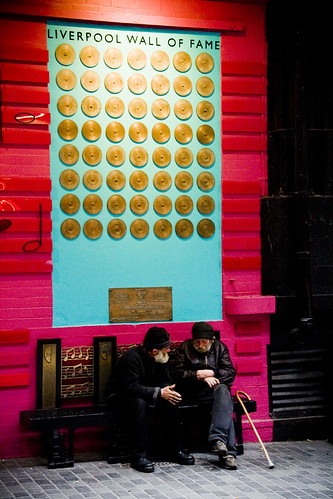
Liverpool Wall of Fame: sadly representative of the contrast between economics and cultural wealth.
Human warmth.
There is this weird thing about people coming from the North. I say "weird" because, the North of France is on the same parallel as the South of England, and yet inhabitants from Newcastle, Durham, etc. have more in common with French citizens of Arras or Lens than their cousins from Cornwall. I could have said "weird" because of their common use of strange language, not to say dialect, that puzzled the rest of their respective nations. It would seem that your relative geographical position instates some kind of cultural determinism.
Most of the time, people from these regions are mocked for their hearthy culture, their lack of sophistication, their pub crawling habits... But this year they had their revenge. On both sides of the Channel, the North stroke back.
There is a quote in French that says that "people from the North have in their heart the warmth they don't have outside". This year has proved to me that this adage was true, with two encounters with the bespoke cultures. On the one hand, Dany Boon's blockbuster "Welcome to the Sticks" (Bienvenue chez les Ch'ti), on the other hand "Billy Elliot" the musical.
Since both of them fully deserved it, I wanted to dedicate this article to them, and through these lines pay my tribute to these regions which deserve to be recognised for more than the stereotypes still associated to them.
Crying twice.
I will be brief with "Bienvenue chez les Ch'ti" because I have already written an extensive article about this film which is now the second best performing film ever in France: 20 329 376 tickets sold, 650 000 DVD only on the first day it was released. This represents just a few tickets less than Titanic, not bad for a local comedy with limited marketing firepower.
The pitch is the following: a post office manager from Marseille is transfered to the North because he tried to bribe a colleague to get a promotion. From his point of view, this is the worst punishment ever, until he discovers the truth behind the clichés. Up North, it may be wet and cold, people may speak with a strange accent, neverthless the encounters you make there will change your life for ever. A quote that illustrates this synospsis: "When coming to the North, people from other parts of the Hexagon cry twice: once when they arrive, once when they leave...".
This tremedous success has spread beyond French borders. The film was a hit in Germany, Belgium, Switzerland... The rights have been bought by Will Smith himself who wants to direct a remake, just like the Italians will do. That is the power of the North: making you weeping with laughter.
Striking the stage.
Same cardinal point, different country, different emotions. In Billy Elliot musical, you may laugh at times, but you cannot avoid being touched by the feelings conveyed by the story of this little boy fighting through tough times to make his way to become a ballet dancer. Although both regions share a lot, like their mining history and the social difficulties they went through when coal mines had to close one after the other, the musical decided to shade a different light on the events.
The Billy Elliot story is set against the background of the British miners' strike of 1984/85 and charts the fortunes of the striking men alongside Billy's personal struggle to become a dancer in a world of hard hats and boxing gloves:
I must admit that I was reluctant to pay my visit to the Victoria theatre. I saw the movie on TV once and was not specifically keen on seeing more of it. And yet, I walk pass the the theater everyday, so I dragged myself in one night to buy some tickets. Having resisted any further would have been a mistake. The show conveys political messages, social hopes, touching lyrics, astonishing decors, and brilliant on-stage performances by actors of all ages. It also allowed me to discover another part of the British modern history through the voices of these people on stage. This is really rich an experience that I strongly recommend to anybody reading these lines.
Be it through comedy or through touching musicals, people from the North do have something in common: they tell great stories. So next time I will be asked where the heck is the North, instead of pointing my forefinger in the right direction, I might be tempted to raise another finger, my thumb. Thanks for these great moments.
OK it's now almost Christmas and all the companies are holding their breath. The retail industry and all the analysts are set behind their reporting matrix, a cup of coffee in one hand, a minced pie in the other. At stake is the answer to the very current dilemma: will the Homo Consumeris celebrate Christmas just like every year, forgetting about the economical downturn and indulging in some seasonal shopping spree? If yes, then you can expect some light at the end of the tunnel, but if not... we are all doomed. Snow will fall in May, Brits will start eating meat with some dodgy mint sauce, Sunderland might even start winning games back to back... Brrrrr... Frightening!
Dried turkey: reheat 2 minutes and stir.
Anyhow, every one concur: we are at a milestone date and any effort to help the scale move in the right direction is welcome. Enters AKQA, the creative digital agency. To celebrate the holiday season, or Christmas as we dare to call it in provocative Europe, the creative team have shot a very compelling and consumerist season greeting video. Not really eco-friendly, but at least it remind us all that it does not matter if your bank has gone bankrupt, that you had to sell your villa in St Barth and your Ferrari's. If you cannot treat your City mistress with stuffed turkey this year, well you can always indulge yourself with Pot the Noodles. Merry Christmas to you all.
It is always fun to live in a foreign country using a foreign language, even when the later is English. Obviously, although Shakespeare's mother tongue is now widely recognised as THE universal language, outperforming Esperanto, there are still major vocabulary differences from one English-speaking country to the other. That for instance led George Bernard Shaw (1856-1950) to claim about UK and US that they were ‘Two nations separated by a common language.’
Hang on to your haggis.
I often write in this blog about how languages can be fun for non native speakers (read here for a selection of articles) who discover that indigenous words might mean something quite different in their own language... Now imagine what it is if you are said to share the same language!
Chris Rae, a Scottish blogger and eventually colleague, writes “The Septic’s Companion” as a guide to British culture and slang. He once lived in the US and realised that his colloquial expressions were not receiving as expected. And that is an euphemism. You may smoke a fag in the UK, but don't you dare calling someone in the US that way, or you might end up with a punch in your face or with an date in the Village. Over there, their chavs have red necks. Their nosh is faster...
Loads of great fun reading Chris' book and blog, so a great Christmas present to anyone who has to deal with the other side of the pond (or a great "Holiday present" shall I say to remain PC):


 to
to