The French literature features a novelist from whom I feel close to. Not that I have an ounce of his talent (although my French teacher often criticized my prose as "as circumvolutory" as his, and this was obviously no compliment), but because he came up with some concepts which are so true to me. And even proved so earlier today.
In Search of Lost Time.
Marcel Proust is a writer, born in the XIXth century in Paris, who focused his writing on memories and time (again nothing to compare to my article on the same topic though). A psychological attitude is even referenced after his name: the Proust effect or involuntary memory. The later has been materialised in a novel where the hero, walking by a patisserie, was brought back to his childhood memories by the mere smell of a freshly-backed madeleine. We commonly name this phenomenon "Madeleine de Proust" (Proust's Madeleine): the activation of deep-buried feelings or memories by an exogenous event.
As mentioned above, this happened to me this afternoon again. No I have not eaten a madeleine (I am trying to put off weight before the Christmas season really kicks off). But making my way through to the nearest tube station, I came across a street where a short-lasting forest of Christmas trees has arisen. A few seconds at the corner of this street, and I was gone. Back there. In my mountains...
A breeze of fresh air.
For me the smell of the evergreens, of their sap... brings me immediately back to my mountains where as a child I was wandering in the snowed forest, looking for our victim. The tree that will throne in the middle of our chalet with its lot of balls and decorations. But don't get me wrong, I am neither nostalgic, nor home-sick. After all, there are so many things happening in London that evoke my home, that I feel at home here. Food, skiing, deers, now the evergreens... As soon as I will find some Chartreuse in pubs and stop sipping my own reserve, then I think we will be there: London will be on the French map of Alps! Because as they say in the latest (pseudo-trendy, though crappy) advert for the Tourism Board of the French Alps... "J'adore la montagne" (I luv' da mountains):
I already wrote an article about "yogurt singing", a practice that consists in singing approximate lyrics on a foreign song or in using onomatopoeias to reproduce sounds that come to our non-educated hear. An example? Let's say that the original lyrics is "wanna gain freedom", a nice politically-engaged line, now in yogurt that could become "one again three four" (don't get it? read it fast, with a strong French accent, and you will end up getting it).
A spoonful of notes.
The singer tries to foul his audience, or even himself, that he can sing. That helped a lot of wannabes in the sixties, but now, with English taught in French primary schools, it becomes more and more difficult to make a living with yogurt's (unless it is organic, sugar- and fat-free, but this is a digression). In other words, the only yogurt users are nowadays individuals in their bathroom with only a plastic duck as an audience.
Ken touched this.
But the insight remains intrinsically true. When you don't master a language, you tend to refer to the few words that you know and think you recognise them. It is not a matter of understanding what you speak, it is a matter of reinsuring yourself that you are capable of something... Berlitz has just released a new ad on the web using a very nice graphic design execution, but before all relaying on this market truth. Strategically right, well executed and supported by the cult MC Hammer, Man... I lov'that!
Edit: the MC Hammer ad has been deleted, but the same idea has been developed on the La Bamba soundtrack. arriba!
Recently, as I have been looking for my next job after year and a half in web agencies, I was regularly asked what would be the greatest achievement of the Internet. This question has been haunting me for a while, and I recent night out with fellow bloggers, Sandrine and Raphael, has provided me with the first elements of an answer.
A revolution, but which revolution?
I don't think that the greatest revolution of the worldwide web are social networks and their ability to empower common people with a powerful communication tool. I am convinced that it is not either the possibility to visualise information or emotions through new taxonomies like tag clouds, or the magnificent work by Jonathan Harris like wefeelfine or universe.
No, I think that the major achievement of the Internet is more behavioural than technological or social. Internet indeed allowed to transform nerds into inspiring people! For years they have been ridiculed, they were thrown stones at... And suddenly their vision of the world was valued millions, and their sex appeal (or at least social appeal) followed the ascending curve of their bank account value.
Call me Sir Geek
Today, being a geek is no longer an insult, it is even somehow hype and inspiring. Belonging to the RSS feed subscribers who read their latest blog posts on their 3G+ devices whilst watching streamed content on their sopcast players signifies almost being part of a cast of superheroes with super social powers... They are on the front cover of glossy magazines, interviewed on TV and newspapers. Or am I just making this up just to reinsure myself that I am no outcast.
But then, if we listen to this anticipation video, the geeks could even one day become semi-gods... That kind of interest me, if my current job hunt was not successful:
The first time I heard of subliminal images was probably in the 80s after I watched a Columbo episode where some film editor killed a rival by influencing through hidden images in a film. Since then, I have paid a lot of attention to this technique which is, as you would agree, quite puzzling.
Thanks lieutenant!
What is a subliminal image? This is an image you don't consciously perceive but which will be processed by your brain. For instance, the classical cinema camera used to shoot at a speed of 24 image per second. In fact, you don't really need these 24 images to give back the smooth movement of reality: your eyes capture them all and your brain process them all to give you the feeling of a continuity whilst it is in fact the apposition of 24 still images. So now, if you substitute one of the images of this desert scenery by one single image of chilled glass of a fizzy refreshing drink, then expert says that your brain is tempted to unconsciously produce a stimulus of thirst and a predisposition to go for a lemonade... And that is how the bad guy manage to kill his victim in that Columbo episode.
Politics, sex...
Obviously such influential practices are not hard facts. They are hard to prove as they are highly dependant on the context in which they are used. But still, subliminal images have marked the last decades with some major examples. Like porn in children cartoons! You might remember the 35th Disney cartoon "Who Framed Roger Rabbit" and its sexy character Jessica Rabbit. Well to increase her appeal, some animators decided to add some subliminal image of Jessica naked in the motion picture. This true legend was then a major factor of sales when the film went out on since-disappeared Laser Discs because it was at that time the only public technology allowing you to truly visualise a film frame by frame.
Another example of subliminal images made a politico-media scandal after 1988 presidential elections in France. Francois Mitterrand was elected for the second time in a row, and some experts identified some puzzling images on the state-owned channel Antenne 2 (now named France 2). The introduction of the news programme was an animated three-dimensional "a2" rotating in the air until the speaker was on screen. A careful look at this 3D animation revealed that there was a face which could well be Mitterrand's was blended in the metallic texture of the figure. When you know that a) the regulation forbids subliminal images, b) candidates are due to an equal speech time and c) Mitterrand was said to have a harsh hand on media, especially on national TV, you can easily conclude, as many did, that this image was not here by chance. So unfair practice from an influential political leader and president or not, we will never know the truth. On the other hand, during the 2000 American election campaigns, the intentions were clearer. During a TV spot for George W. Bush, the future president was presenting his opponent's programme under his own light. And to increase the negative perception of Al Gore, some subliminal messages were displayed alongside, like this one, briefly but clearly insulting the Democ....rats! Look me in the eyes.
The influence of these images has not been scientifically proven though. The French ophthalmologic website Ophtasurf reports that:
A Canadian TV network has run an experimentation displaying 300 times a subliminal call-to-action during a popular show. The message was encouraging viewers to "Call now" but no significant upraise in calls was noticed. Psychologist Ahmed Channouf from University of Provence in France explained that too complex messages have no chance to be understood properly by a brain in milliseconds, and would consequently have no impact on behaviours.
Several scientists confirm that there is no possibility that such a brief visual stimulation would influence consumers to buy a product against their will. Eventually it could increase a propensity to act, but not alter the predispositions.
Or couldn't it? Well, this post was prompted by a visual stimulus... I have seen on the Internet an excerpt from E4 programme presented by illusionist Derren Brown. This is obviously not a scientific demonstration, but interesting and puzzling enough, don't you think?
Funny enough, when I saw this film for the first time, I spotted the harp, and this made me think of Guinness. Isn't that another proof of the influence of symbols? Not sure, but why not have a beer...
The mouth has been a central element of our beliefs, for ages. If you have been to Rome, you might even remember having seen tourists stuffing their hand in an open-mouthed stone face which is said to keep liars stuck. I personally did not try my luck, after all, I am working in advertising... Too dangerous.
Bocca dela Verita, Rome - Italy
Anyway, the mouth is key as many customs demonstrate it. Primal tribes were convinced that they would acquire their enemies' strength by ingesting their organs. Toreros are offered some "pieces" of the vigorous bulls they killed in the arena to increase their virility and courage... My name is Bud, Dr. Taste Bud
There is a less-bloody version of these convictions. A more modern too. It consists in considering that you can influence your health through you food. In French, we call such products "alicaments" which is the combination of "aliments" and "médicaments" (food and medicine, or nutraceuticals). Eat this yogurt and you will decrease your risks of stroke. Drink that juice and your blood pressure will stabilize. Swallow this pill and your tanned skin will resplend...
Functional food becomes a massive trend in nutritional research, and consequently in marketing. But the idea to process food to optimise their intrinsic nutritional properties raises also some debates about genetically modified organism... Overall this trend is at its early stage, and consequently their are many grey areas around it. What are the implication on the longer term for instance? So how to surf on this remunerating trend, whilst remaining cautious... Well, my favourite retail store, Tesco, has found the solution. After promoting some deviant sexual practices or perverting our children, they are now entering in the nutraceutical arena, but with loads of caution... And that leads to that king of packaging non-sense:
"Goji Berries. A source of vitamin C which may help maintain a healthy immune system"
Buy and eat this, it you may, or may not, get better. But in any case, buy it: it will definitely make us better off!
This blog is usually focusing on cultural differences. Most of the time I shade some light on cultural facts that make me laugh or at least amaze me. But for once, this post will celebrate cultural commonalities.
For a change.
If you have been reading this blog with attention for a while, you know Flavien, a friend of mine who decided a year ago to quit his job as a salesman to ride a bike from Paris to Jerusalem (first article here, the second here). Well, Flavien is about to pedal again. This time, his journey will start from the Holy City of Jerusalem and he will close the loop he initiated in 2006: he is about to cycle from Israel to France from the Southern side of the Mediterranean sea.
His earlier trip in the Middle East remains a vivid memory in Flavien's mind. The few conversations we had since, be it over the phone, on MSN or in person, are all consistent. Flavien has a true passion for Jerusalem, without being really able to put words on it. So instead he puts pictures on it... This led him to offer me the art book which inspired this post. The book of the eponymic Face2Face project is what British people would call a coffee table book, but it gives you more than coffee to brew. It make you think.
Portrait their resemblances. JR, the photographer, and Marco, the scientist, both authors of this extravagant adventure as they qualify it, have introduced their book in such a brilliant way that I don't dare changing a word:
When we met in 2005, we decided to go together in the Middle-East to figure out why Palestinians and Israelis couldn't find a way to get along together. We then traveled across the Israeli and Palestinian cities without speaking much. Just looking to this world with amazement. This holy place for Judaism, Christianity and Islam. This tiny area where you can see mountains, sea, deserts and lakes, love and hate, hope and despair embedded together.
After a week, we had a conclusion with the same words: these people look the same; they speak almost the same language, like twin brothers raised in different families. A religious covered woman has her twin sister on the other side. A farmer, a taxi driver, a teacher, has his twin brother in front of him. And he his endlessly fighting with him.
It's obvious, but they don't see that. We must put them face to face. They will realize. We want that, at last, everyone laughs and thinks when he sees the portrait of the other and his own portrait. The Face2Face project is to make portraits of Palestinians and Israelis doing the same job and to post them face to face, in huge formats, in unavoidable places, on the Israeli and the Palestinian sides. In a very sensitive context, we need to be clear. We are in favor of a solution for which two countries, Israel and Palestine would live peacefully within safe and internationally recognized borders.
All the bilateral peace projects (Clinton/Taba, Ayalon/Nussibeh, Geneva Accords) are converging in the same direction. We can be optimistic. We hope that this project will contribute to a better understanding between Israelis and Palestinians. Today, "Face to face" is necessary. Within a few years, we will come back for "Hand in hand".
This book is the embodiment of a wise, ambitious, and totally unofficial initiative that deserved to be better known. So, I am glad to spread the word. Be it Shalom, Salaam or Peace. You can buy their book and some posters here. And trust me it is totally worth it. And because images are worth a thousand words, here is a a video about this project, that will certainly finish to convince you:
If you are a regular reader of this blog, or even if you know me personally, you are certainly well aware that I recently got married. This major change in my matrimonial status is also a fantastic opportunity to exchange with other people, other cultures, on a very intimate topic. It is also a source of cultural differences.
Girls want to know all about the bride's dress and her hair style, boys prefer to share the discovery of the bride at her father's arm. The French want to know the menu, the English the location. Some inquire about our choice of texts for the celebration. Others want to know the first dance and whether we learned the three steps of waltz... But the most interesting inquiries came from our friends in Canada: they wanted to know if my wife will keep her maiden name.
Gender-neutral society
This question is indeed critical over there. As a matter of fact, Canada is not only the first nation of Hockey as you can have learned here, it is also a country where the disparities between the two genders have completely been eradicated. Everything is now set so that men are not privileged for obscure reasons like this is unfortunately still the case around here. And obviously neither are women.
This is quite puzzling for foreigners. For instance, forget the courtesy rules that are the basics of French etiquette: in Montreal, a man should not hold the door for a woman, that could be considered as breech in local manners. So you can probably imagine what the most feminist of our friends felt when she received her third door in the face... She actually started to miss the good old traditions!
Anyway, back to our wedding story: why should a girl lose her name when she gets married? It could be perceived as a sign of allegiance to her husband... And as a result, many Canadian women keep their maiden name when a ring is slot at their finger. Do I need to mention that it is a true nightmare for genealogists, especially when you know that the children tend to follow the same norms: the son would have the father's name, while the daughter would be named after her mother. So brothers and sisters might not share the same name!!!
Tradition and rules
In France, there is rule and tradition. The later is that the bride takes the groom's name. However this is not the law, which is in fact not restricted to the tradition. Probably motivated by the same philosophy as in Canada, the French regulation is quite flexible, even more than in Quebec. In France, a bride is allowed to take her husband's name, to retain her maiden name, to associate both... And the husband can do the same. So he could choose to be named after the maiden name of his wife.
To be honest, I have not met anyone who had opted for the last option. Consequently I assume that the main reaction would be surprise. In France, and I think in the UK too, we have an idiom that says "he/she wears the pants in the family" in order to identify who rules the household. In fact, in that specific instance, the word "culotte" that we use in French for "pants" is an old word that translates nowadays in "panties". Call me a sexist, but I imagine that if the husband was to drop his name for his wife's, people would probably claim he has let the ownership of the panties to the lady of the house... However when you know how appealing and disconcerting a bride's lingerie could be, you could probably forgive him, couldn't you?
An advert for Aubade lingerie part of a long-lasting campaign named "the Lessons of Seduction". This is lesson #57: "distract the opponent". Quite efficient, isn't it? More lessons here.
This could have been a tribute to the Beatles... But it is simply a farewell to a train station that has witnessed so many Anglo-French reunification and ruptures. Farewell Waterloo. Hello St Pancras...
A month ago I lectured at a French University about advertising. My ambition was to share my passion about this profession while killing some myths... I was glad to see in the eyes of my students (I love writing that) the same sparkle that I had at their age (I hate writing that, dammit).
We discussed at length the elements that make a good ad, trying to identify the key factor of success of a campaign: innovation, engagement, integration... However, I now realise that I did not refer to how great ads are rewarded for their success. I am not talking about the dusty trophies decorating agency halls, but about evidences that an ad has truly cut through to be adopted and endorsed by the entire society. Advertising break.
So when can you tell that an ad is a success? Probably when it manages to get out of the advertising space and blend in our daily life. A French example comes instantly to my mind: Cadum. Cadum is a soap brand created in 1907 and later acquired by Colgate. Its brand icon was a baby, the "Bébé Cadum", whose skin was obviously soft, healthy, etc... Thanks to the packaging and the advertising, the expression "Bébé Cadum" became such a norm that you could almost no longer dissociate both words. A nice toddler was de facto a Baby Cadum, as a giant was... green. The word "Baby" was in a sense totally branded. A branding that lasted beyond the product...
As a matter of fact the brand disappeared more or less in the 80s but one thing remained... Its usage as a substantive. Back then, although they had never been in contact with the product or the brand, toddlers were shouting at each other: "You are a Baby Cadum!" I know this too well: I used to be one of these loud talkers in nappies... And trust me, when you were called a "Bébé Cadum" in a schoolyard, that was a call for war. The youngest were ridiculed by the older, until they can revenge the following year when they finally were no more freshmen and could rule the world, or at least the kindergarten. And so the word passed from generation to generation.
The success of humour.
There is another situation which illustrates that an ad has truly managed to become a reference: when it is spoofed. After all if other people, be it brands, humorists, film directors, copy your codes that definitely means that you have reached a certain level of awareness. Otherwise the reference would be void, would not it?
To illustrate this, I have selected three great examples of TV commercials which were spoofed by other brands, three of the most successful and awarded ads of the last years. I have displayed them so that you can enjoy the original first, and then appreciate its spoof:
Sony Bravia "Balls": Fallon demonstrates the richness of the colour palette provided by the Sony LCD screens using thousands of bouncing balls thrown away in the street of San Francisco. The spoof? Tango, a British fruit drink that has been renowned for years for its madness...
Honda "Cog": Wieden+Kennedy London actions all the individual elements of a car to make things work. The spoof? The Number and its 118 118 fellows.
Cadburry "Gorilla": a pure moment of pleasure provided by Fallon again, just like the one provided by a Cadburry chocolate. The spoof? Wonderbra, a pure moment of pleasure, just like the one provided by the lingerie.
To become such myths, these brands have accepted to let go and not tried to control everything. Their brands have been turned into mere adjectives, their ads into jokes... But to a certain extend, these are just the signs of a great empathy between the brand and its consumers. And the empowerment of your audience becomes even more critical nowadays with the rise of the internet-based social networks. Communities have now the tools to communicate, and brands have always been a center part of discussions. So if they want to follow the pace of their consumers, brands need to accept the rules. And being hijacked could be a possibility. For some brands this is even an ambition, since it would signify that they had become a reference.
I recently posted a note on the possibilities to find French lessons even in British high street sex shops... Well, YouTube is also a great place to find such lessons.
Two Kiwis in the Big Apple
Browsing videos, I bumped into some extracts of a new HBO TV series: Flight of the Conchords. According to the channel:
Flight of the Conchords follows the trials and tribulations of a two man, digi-folk band from New Zealand as they try to make a name for themselves in their adopted home of New York City. The band is made up of Bret McKenzie on guitar and vocals, and Jemaine Clement on guitar and vocals. Bret and Jemaine have moved to New York in the hope of forging a successful music career. So far they've managed to find a manager (whose "other" job is at the New Zealand Consulate), one fan (a married obsessive) and one friend (who owns the local pawn shop) -- but not much else.
So when two kiwis try to make their way in the US, they obviously try to develop their private life too. And they then rely on French flair in such instance...
France 0 / New Zealand -1
As you may know New Zealand and France have a very special relationship since our secret services bombed a Greenpeace boat in Auckland harbour, killing accidentally a member of the Rainbow Warrior crew. Since this interference in local affairs, Kiwis benefit from privileged conditions when coming to France: they can stay longer than other non-EU visitors, get a temporary working permit more easily... This is what happens when guilt and diplomacy work hands in hands.
Anyway, due to this relationship, Kiwis seem to be attracted by France. Our mountains, sheeps and shores must remind them of their green pastures when they come to old Europe (not sure that the typical French Rugby player reminds them any of their Blacks though)... So to get ready for their immersion in the Hexagon, they try to learn French at school, between two Maori and sheep breeding classes. This is hardly a success for French is quite complex a language and the opportunities to practice in their country are rare now that Chirac has decided to stop the nuclear bomb tests in the Pacific Ocean. But they can usually articulate a few words and imagine mastering the language of Molière and its appeal:
I remember one of my former kiwi colleague who could actually manage only two sentences of proper French: "Je voudrais une baguette" and "Prochain arrêt, le pub" ("I'd like a baguette" and "Next stop the pub", critical to survive you may say). Every time I was coming to his desk, he was repeating them in loop adding some onomatopoeias in between to pretend he could speak French... No blame on him, we are doing exactly the same when it comes to "speaking" English (read here).
Anyway, I love Kiwis for their natural and friendly way of living. I like their country and hope to be soon able to discover the great diversity of sheepkind. I enjoy seeing the All Blacks playing rugby (even when they accept to lose against France during World Cups). And I am really looking forward to seeing the Flight of the Conchords on TV... But in France we have a idiom that says "qui aime bien, châtie bien" (whoever likes you well gives you hell, or as you say in English "spare the rod and spoil the child").
Who could have thought that even Ann Summers' would apply this rule? Now thinking about it, no one better than a high street sex shop could teach French to the masses. I mean real French, the foreign language, not the... you dirty pervert ;-)
As a matter of fact, Ann Summers displays no dog in a black and white coat in its window, but there are usually lady apparels and toys for doggy habits. Sometimes, however, the shop becomes more prude, and decides to have more didactic an approach. This picture was indeed shot a few weeks ago in London and, as you can see, the manager decided to deliver moral anatomy classes in French: the three "key" areas of the female body are clearly labeled as "Sale" (or "dirty" in French).
Not so long ago, nuns running girl boarding schools would have appreciated this incongruous support...
Have a look at this commercial. You might have already seen it on UK television as it was released very recently, but please watch it again. This is the third opus of the Sony Bravia campaign created by advertising agency Fallon London. After Balls and Paint, the color.like.no.other slogan is now demonstrated through a wave of play-doh rabbits in the streets of New York. Neat, creative, original... Well, there is some controversy around this later adjective as you can read it here and here, but this is not the purpose of this post.
I indeed want you to have a second look at it. Watch, and pay strong attention to details. Have you noticed now? No? Then have a third go... Focus on the first scenes. There, yes, on time-code 00:15. Indeed in the background... The red and white patch of colour. This is the real invasion of the TV commercial. Who cares about clay rabbits when aliens are amongst us...The bespoke patch is in fact a mosaic by French street artist Space-Invader, laid in 1999 in the street of Soho, in NYC (a better view is available here).
Addiction to invasion
I can already hear some of you in the back saying that I am probably the only one to have noticed this elusive presence in the back. The artist himself confirmed to me that he was not aware of his work being integrated by Sony, although he assumed that the director would have probably selected the location on purpose.
To a certain extend I agree, this is quite a furtive presence and you need to be trained to noticed such an invader in a urban surrounding. However I am not the only one to hunt these little space-invaders inspired by the eponymous video-game. More than a training this is an addiction shared by numerous street-art fans around the world who for instance keep track of their encounters on FlickR:
One of my own pictures, "Space-Invader is Watching you", more FlickR shots available here
When I use the word of "addiction", this is not too strong a word. I discovered the artist in the 90s in my home town of Grenoble, but was properly contaminated in London when I started taking pictures of the various mosaics I was seeing here and there. Since I have completely modified the way I walk in the street.
At every corner, I give a quick look over my shoulder, just to check that I have not missed one. Space Invader depicts is work as an "invasion of the (public) spaces", and you can read more details about his approach here. So, potentially, every location can host one of them... In Montpellier, for instance, the locations of mosaics were chosen so that, when placed on a map, they would form an image of a character. In London, their infiltration seems to be less systematic, and more random. It is consequently even more challenging to find them, especially since they are short-lived. Two of my discoveries in Farringdon and Brick Lane have already disappeared, stolen or taken down by the city services...
Convinced or interested in this artist, let me suggest to have a look at the street corners of your own city since Invader has already been active in more than 35 cities around the globe. There might be one of his mosaic just next door, looking at your car. Alternatively, for the lucky London readers, you can opt to visit the exhibition dedicated to his recent work at LAZARIDES gallery 8, Greek Street Soho, London W1D 4DG. Though don't expect any Sony camera there, unfortunately! However if you are really into Bunnies, I then recommend the current exhibition at Cosh Gallery, with some modern graphic design works on this animal ("The bunny show", until octobre 22nd, exhibition featuring Ben Frost, Hydro74, Bemodern, Mudwig, Si Scott, Airside, Pure Evil, Keith Watts, KozynDan, Mr Ian Wright, Pandayoghurt, Sean Alexander, Slinkachu, John Cossey...).
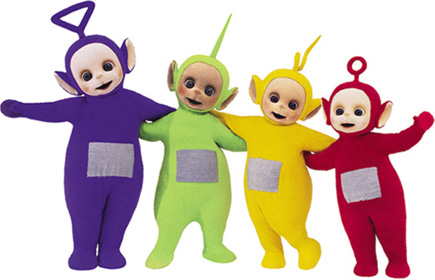
Let me introduce this apparently nice lot: from left to right, Tinky Winky, Dipsy, Laalaa and Po. If you have young children at home, you probably think you know too well those creatures and their very special language made of weird onomatopes. Well, you think and you are wrong. Under the furry cover hides the evil: the Teletubbies are in fact double-agents... Liebst du Sie noch?
I personally discovered them in 1998 when living in Germany. I know that was two years after they went out of their Tubbytronic Superdome for the first time, but I had an alibi: I was 22 (slightly overage to be an early adopter). In Germany, like everywhere, the 4 characters were a phenomenon. Every child was in love with them... And I was curious. As a man of image, I was interested in the signs vehicled by these new icons.
I reckon I am no literate semiologist, however, there are some signs that were too obvious to be ignored:
"Po" in German means Arse, and when you look at the Antenna of the relevant character... well, it is self-explanatory;
Dispy's antenna, on the other hand, would be the centre-piece on any Dali's painting as the perfect phallic representation;
The colours of this TV shows are reflecting the same spectrum as the Gay Pride flag;
The TV programme was bought in France by Canal+, a paid-for TV broadcaster who was successful through football and Saturday night porn (there is obviously no ball in the Teletubbies...)
And moreover, the episodes were infiltrated by what can be perceived as subliminal demonstration of Kamasutra positions:
Stop the conspiracy
So when last year, Reverend Jerry Falwell, former spokesman for America's Moral Majority, denounced the BBC TV children's show because Tinky Winky would be gay, I was relieved. I was no longer isolated. I knew that there were forces elsewhere to fight on my side against this conspiracy to turn our children into sex-slaves.
Seriously, I have decided to boycott this TV programme. So now every time I hear Itsy Bitsy catchphrases, I lock my daughter, Emmanuelle behind the green door of her room so that she can finish her essay on French literature... What was that book again? Oh, yeah... "Justine, ou les malheurs de la vertue" by Marquis de Sade. Now if with that kind of leisure time she does not get AAAAaaaaaah's at school, I don't understand anything at child education.
Bacardi is well known for its tradition of mixing... They have launched a new TV commercial recently that illustrates this habit. Well executed in the below stated version, unfortunately the edited version that can be seen on the screens is less engaging:
Just looking forward to seeing how these brands can investigate other territories than music mixing which is now an overused cliché. When will they look at mixing the cultures for instance?

 As mentioned above, this happened to me this afternoon again. No I have not eaten a madeleine (I am trying to put off weight before the Christmas season really kicks off). But making my way through to the nearest tube station, I came across a street where a short-lasting forest of Christmas trees has arisen. A few seconds at the corner of this street, and I was gone. Back there. In my mountains...

 " and its sexy character Jessica Rabbit. Well to increase her appeal, some animators decided to add some subliminal image of Jessica naked in the motion picture. This true legend was then a major factor of sales when the film went out on since-disappeared